
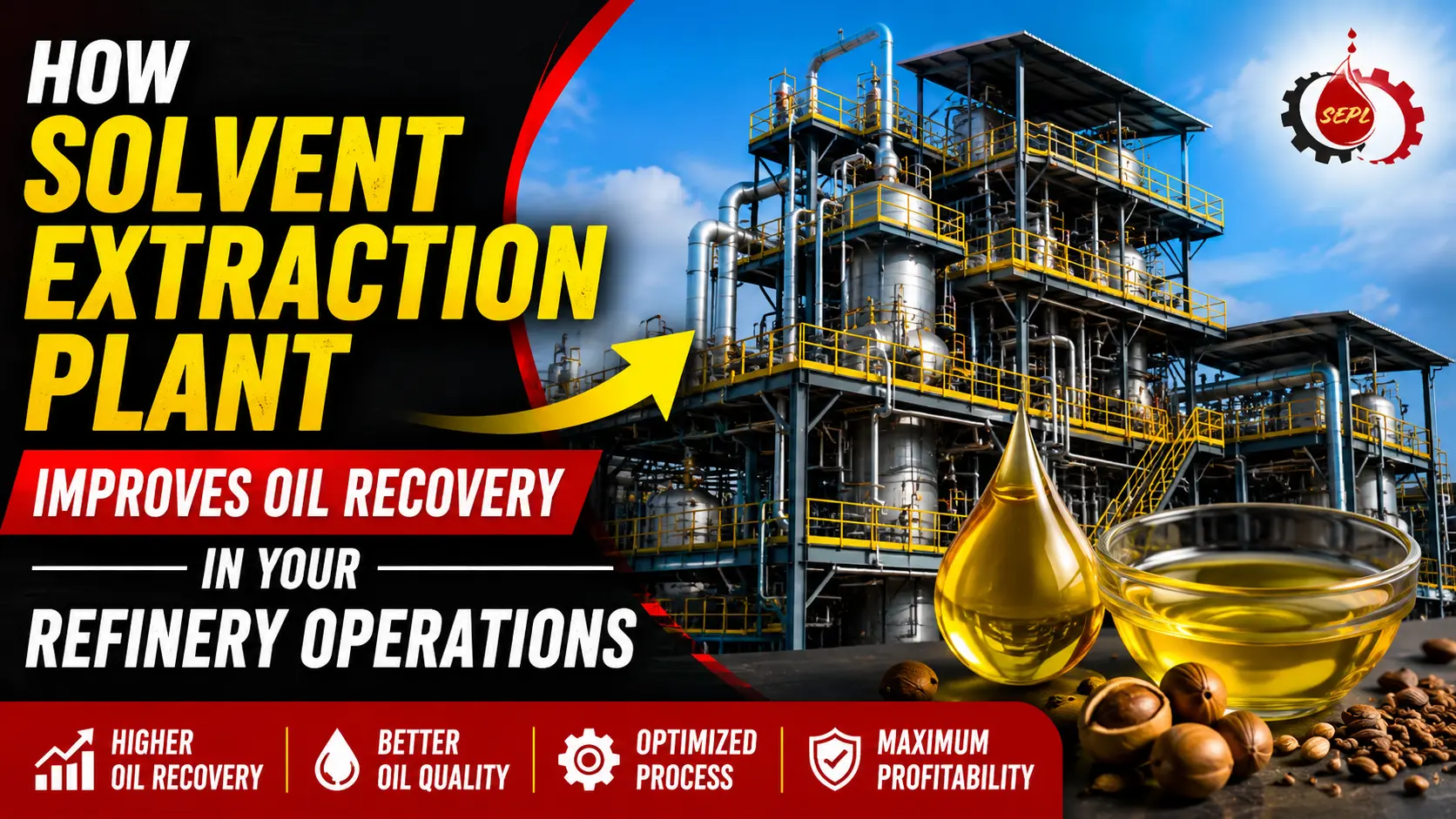
For most edible oil businesses, margins are decided long before the oil ever reaches a bottle. They are decided at the extraction stage, in the percentage of oil a plant manages to pull out of every ton of raw material it processes. Two facilities running the same oilseed, the same tonnage, and the same market price can end up with very different profitability simply because one recovers 98 percent of the available oil and the other recovers 94 percent. Over a year of continuous operation, that gap adds up to a significant amount of lost revenue.
Understanding how solvent extraction plant improves oil recovery is not just a technical curiosity. It directly affects your bottom line, the quality of crude oil reaching your refinery, and how smoothly your entire refinery operations run downstream. This blog goes through the actual process, equipment, and economics involved, so you can see exactly how solvent extraction plant improves oil recovery and where the gains typically come from.
Why Oil Recovery Is the Real Profit Lever in Edible Oil Processing
Mechanical pressing alone, even with modern expeller technology, typically leaves 5 to 8 percent residual oil trapped inside the cake. That oil is gone unless a secondary extraction step recovers it. Solvent extraction exists precisely to close this gap, bringing residual oil content in the spent meal down to below 1 percent in a properly run plant.
This is why almost every medium to large scale edible oil business eventually adds a solvent extraction stage, even if it started with pure mechanical pressing. The economics are straightforward: a pre-pressing plus solvent extraction setup typically increases initial investment by around 18 percent compared to pressing alone, but raises annual gross profit by more than 30 percent, which shortens payback periods considerably. The extraction stage is not an added cost; it is where the real return on investment comes from.
What Determines Oil Recovery in a Solvent Extraction Plant
Oil recovery efficiency is not decided by a single piece of equipment. It is the cumulative result of several factors working together: extraction speed, permeability of the prepared oilseed bed, height of the material bed inside the extractor, operating temperature, and the viscosity of the oil itself.
Extraction speed refers to how quickly the solvent reaches equilibrium with the oil inside the material, essentially the time needed for a poor (lean) miscella in contact with fresh material to become a rich miscella. Operating temperature has to stay below the vaporization point of the solvent while still being warm enough to reduce oil viscosity and speed up diffusion. Bed height and material permeability decide how evenly the solvent spreads through the material without channeling through weak spots or flooding in dense ones.
These factors cannot be improved one by one. They all affect each other, so they must be checked and optimized together. A plant with a state-of-the-art extractor but poorly prepared material will still underperform, which is exactly why a solvent extraction plant manufacturer in India has to design the entire system, from material preparation to solvent recovery, as one connected chain rather than a collection of separate machines. This connected approach is the real answer to how solvent extraction plant improves oil recovery in practice, not any single machine working alone.
How Hexane Solvent Extraction Maximizes Oil Yield
Hexane has remained the dominant solvent in the edible oil industry for decades, and not by accident. It has low miscibility with water, which makes recovery and recycling straightforward. It has a relatively low latent heat of vaporization, which keeps energy costs for distillation manageable. And it performs reliably across nearly every major oilseed type, including soybean, rice bran, mustard, sunflower, and cottonseed.
In a typical hexane solvent extraction setup, prepared oilseed material enters the extractor, where fresh solvent is sprayed over the moving material bed in a countercurrent arrangement. Fresh solvent meets the most exhausted material near the discharge end, while the richest, most concentrated miscella forms near the feed end where the material still holds the most oil. This countercurrent design is what allows continuous extractors to achieve such high recovery rates compared to older batch or basket-type systems.
Alternative solvents such as ethanol, isopropanol, and ethyl acetate have been studied as replacements, mainly for regulatory and environmental reasons. However, most of these alternatives require higher solvent-to-material ratios, more energy for distillation, and significant retrofitting of heat exchange equipment like economizers and condensers. For now, hexane remains the most practical and cost-effective choice for the vast majority of solvent extraction plant installations.
The Role of Oilseed Flaking and Pelletizing in Percolation Efficiency
This is the stage that gets the least attention publicly, yet it has one of the biggest impacts on actual recovery numbers. Solvent extraction works on a principle called percolation, where solvent flows downward through a stationary or slowly moving bed of material, dissolving oil as it passes through.
If the prepared material is too fine, fine particles fill the gaps between larger pieces of flake, blocking solvent flow and causing what is known as bed flooding. Once flooding occurs, solvent either channels through a few open paths, leaving large portions of the bed under-extracted, or backs up entirely, slowing the whole extraction cycle and reducing throughput.
This is where converting flaked material into pellets makes a measurable difference. Pellets are larger, more uniform, and denser than loose flakes, which means a pellet mill creates a material bed with consistent, open channels for solvent to move through. Better permeability means better contact between solvent and oil-bearing material, and that translates directly into higher recovery and shorter extraction cycles. Pelletized material also has higher bulk density, which means more material fits into the same extractor volume, increasing throughput without expanding the plant footprint.
| Material Form | Bed Permeability | Typical Impact on Oil Recovery | Typical Impact on Throughput |
| Fine, powdery material | Low | High risk of flooding, lower and inconsistent recovery | Reduced, slower solvent drainage |
| Flaked material | Medium | Acceptable recovery, but limited bed height | Moderate |
| Pelletized material (collets) | High | Better solvent flow, more consistent and higher recovery | Higher, denser bed allows more material per batch |
Inside the Extractor: How the Solvent Extraction Plant Process Improves Oil Recovery Step by Step
Once material is properly prepared, whether flaked or pelletized, it enters the extractor, where the actual oil-solvent contact happens. Most modern installations use continuous percolation-type extractors rather than older basket systems, since continuous designs offer better throughput and more consistent extraction conditions.
Inside the extractor, the material moves slowly through a series of stages, with solvent sprayed from above and drained from below at each stage. As material progresses toward the discharge end, it encounters progressively fresher solvent, while the solvent itself becomes progressively richer in oil as it moves backward through the bed, this is the countercurrent principle mentioned earlier. By the time material exits the extractor, residual oil content should be well below 1 percent if the system is operating correctly.
The mixture of oil and solvent collected from the richest stage of extraction is what becomes miscella, and this miscella now needs to be separated back into usable crude oil and reusable solvent. That separation happens in the next stage of the process.
Miscella Distillation and the Desolventizer Toaster: Closing the Recovery Loop
Miscella distillation is where rich miscella, typically containing 20 to 30 percent oil by weight, is heated under controlled vacuum conditions to evaporate the hexane while leaving crude oil behind. This usually happens across multiple stages, often a first-stage evaporator followed by a vacuum stripping column, to fully remove solvent without overheating or degrading the oil.
A well-designed economizer plays a quiet but important role here, recovering heat from the vapor leaving the desolventizer toaster and using it to pre-warm the solvent returning to the extractor. This single piece of equipment can account for a meaningful share of the plant’s total energy efficiency, since miscella distillation is one of the most energy-intensive steps in the entire process.
On the solid side, the extracted marc still retains a significant amount of solvent that needs recovery, both for cost reasons and for safety. This happens in the desolventizer toaster, where direct and indirect steam strip residual hexane from the meal while simultaneously toasting it, which also improves its nutritional value as animal feed. The vapor leaving this stage is condensed and the recovered hexane is sent back into the extraction loop.
This complete recovery chain, extraction, miscella distillation, and desolventizing, is what allows a plant to operate with solvent losses as low as 1 to 2 liters per ton of material processed. Anything significantly higher than that usually points to a worn or undersized component somewhere in the chain. For plants needing to replace or upgrade these components, our solvent extraction plant spares and equipment range covers solvent condensers, solvent heaters, DT spare parts, and miscella pumps.
Solvent Extraction vs Mechanical Pressing: A Detailed Comparison
| Factor | Mechanical Pressing | Solvent Extraction |
| Residual oil in cake/meal | 5 to 8 percent | Below 1 percent |
| Capital investment | Lower | Higher, due to extraction, distillation, and solvent recovery systems |
| Operating cost per ton (long term) | Higher, due to oil left unrecovered | Lower, due to higher yield per ton processed |
| Energy use | Lower per ton | Higher per ton, mainly for distillation and desolventizing |
| Byproduct value | Oil cake with higher residual oil, lower feed value | Defatted meal with low residual oil, higher value as animal feed |
| Best suited for | Small scale operations, low-oil-content seeds | Medium to large scale, oil-rich seeds and high-throughput operations |
| Typical ROI timeline | Faster initial payback, lower ceiling on profit | Slightly longer initial payback, significantly higher long-term margin |
In practice, very few large operations choose one method exclusively. The most common and most profitable configuration is pre-pressing followed by solvent extraction on the residual cake, which combines the lower energy cost of mechanical pressing for the bulk of oil removal with the near-complete recovery of solvent extraction for what pressing leaves behind.
How Solvent Extraction Plant Output Connects to Refinery Operations
Crude oil leaving a solvent extraction plant is far from finished. It still contains free fatty acids, phospholipids, waxes, pigments, and trace amounts of solvent and moisture, all of which affect taste, odor, color, and shelf stability. This is exactly where refinery operations begin, taking that crude oil through degumming, neutralization, bleaching, and deodorization until it becomes stable, neutral RBD oil ready for the market.
The connection between extraction and refining is not just sequential; it is economic. Crude oil that comes out of a well-run extraction process, with consistent quality and minimal residual impurities, requires less bleaching earth, shorter deodorization cycles, and less rework at the edible oil refinery plant stage. On the other hand, crude oil from an inconsistent or poorly maintained extraction process forces the refinery to compensate, burning more bleaching earth, running longer deodorization cycles, and sometimes losing more oil to neutralization than necessary.
This is the core reason extraction and refining should never be treated as two separate businesses on paper, even when they are physically separate units. A gain or a loss at the extraction stage shows up again, amplified, at the refinery stage.
The Economics of Better Oil Recovery: Why a Few Percentage Points Matter
It is easy to underestimate how much a small improvement in recovery rate matters at scale, and this is exactly where the financial case for how solvent extraction plant improves oil recovery becomes clear. Consider a plant processing 200 tons of soybean per day, with an oil content of roughly 18 percent. A 2 percentage point improvement in recovery efficiency, going from say 96 percent to 98 percent of theoretical oil yield, translates into recovering an additional 720 kilograms of oil per day. Across a 300-day operating year, that is over 200 tons of additional oil annually, recovered from the exact same raw material input, with no increase in raw material cost.
This is why experienced plant operators treat recovery efficiency as a continuous improvement target rather than a one-time installation metric. Energy costs for utilities like steam and power typically account for 12 to 16 percent of total product revenue in large refineries, and a meaningful share of that energy goes toward solvent recovery and distillation. Improving recovery efficiency does not just add oil output; it also improves the energy efficiency of the entire recovery loop, since less solvent needs to be re-evaporated and re-condensed per unit of oil produced.
Common Factors That Reduce Oil Recovery Efficiency
A handful of recurring issues account for most of the recovery losses seen across underperforming plants.
Operating temperature that drifts too low slows extraction speed and increases the time material spends in the extractor without proportionally improving recovery, while temperature that runs too high near the solvent’s vaporization point increases solvent loss through evaporation and can affect oil quality.
Worn or poorly maintained extractor internals, including aging solvent extractor chains, elevator chains, and bucket assemblies, slow material movement through the extractor, increasing residence time without improving extraction, which reduces overall throughput and indirectly hurts recovery economics.
Inconsistent material preparation is one of the most common and most fixable issues. Variation in flake thickness or pellet size from batch to batch creates uneven bed permeability, meaning some portions of the bed extract well while others flood or channel.
Aging solvent heaters, condensers, and an undersized or poorly maintained economizer increase both energy cost and solvent loss across the recovery loop, since they cannot recover and reuse heat as efficiently as properly sized equipment.
And finally, undersized or worn rotary valves and miscella pumps can create pressure inconsistencies that affect solvent flow rate through the bed, directly impacting both extraction speed and recovery consistency.
How to Audit Your Existing Plant for Recovery Losses
If oil recovery has been decreasing over time, or if it has never reached the levels promised when the plant was installed, a proper inspection can usually find the problem more quickly than guessing. This inspection normally includes checking how much oil is left in the meal coming out of the extractor (more than 1% oil regularly indicates a problem), measuring how much solvent is used per ton of material and comparing it with the plant’s original design values, inspecting the material preparation equipment to make sure flakes and pellets are of consistent quality, and reviewing maintenance records for key equipment such as the extractor chain, condensers, and desolventizer toaster.
In most cases, recovery losses trace back to one or two specific components rather than the entire plant, which means a full rebuild is rarely necessary. A targeted upgrade, whether that is a pellet mill replacement, new condensers, or a chain and bucket overhaul, is usually enough to bring recovery numbers back in line with design specifications.
Frequently Asked Questions
Q1. What is the average oil recovery rate in a solvent extraction plant?
Well-maintained solvent extraction plants typically bring residual oil content in the spent meal down below 1 percent, meaning recovery rates well above 98 percent of the theoretically available oil. Mechanical pressing alone, by comparison, often leaves 5 to 8 percent oil trapped in the cake.
Q2. Why is hexane used in solvent extraction instead of other solvents?
Hexane is preferred for its low miscibility with water, efficient and straightforward recyclability, relatively low energy requirement for evaporation during distillation, and proven, consistent performance across nearly all major oilseed types.
Q3. How does pelletizing improve oil recovery compared to using flakes directly?
Pelletizing creates a denser, more uniform material bed with consistent permeability, allowing solvent to flow through evenly without flooding or channeling. This results in more complete and more consistent oil extraction compared to fine or inconsistently sized flaked material.
Q4. Can an existing solvent extraction plant be upgraded to improve oil recovery without a full rebuild?
Yes, in most cases. Recovery losses usually trace back to specific components such as the pellet mill, extractor chain, condensers, or desolventizer toaster rather than the entire system. A targeted plant audit can identify exactly which components are limiting recovery before any major investment is made.
Q5. Does better oil recovery at the extraction stage actually reduce costs at the refinery stage?
Yes. Higher quality crude oil with fewer impurities and more consistent composition reduces bleaching earth consumption, shortens deodorization cycles, and lowers overall refining cost, meaning gains made at the extraction stage carry through and compound at the refinery stage.
Q6. How much capital investment is typically needed to add solvent extraction to an existing pressing operation?
Adding a solvent extraction stage to an existing mechanical pressing setup typically increases initial capital investment by around 18 percent, but commonly raises annual gross profit by more than 30 percent due to the additional oil recovered from material that pressing alone would have left behind.
Q7. What percentage of operating costs in a refinery typically goes toward energy and utilities?
Energy and utility costs, including steam, power, and cooling, typically account for 12 to 16 percent of total product revenue in large-scale edible oil refineries, with solvent recovery and distillation representing a significant portion of that energy use.
Now that you understand how solvent extraction plant improves oil recovery across every stage of the process, the next step is reviewing where your own plant stands. If your current oil recovery numbers are not matching your plant’s original design specification, or if you are planning a new solvent extraction setup and want it designed for maximum recovery from day one, our team at Super Techno Engineers can review your requirements and recommend the right configuration.