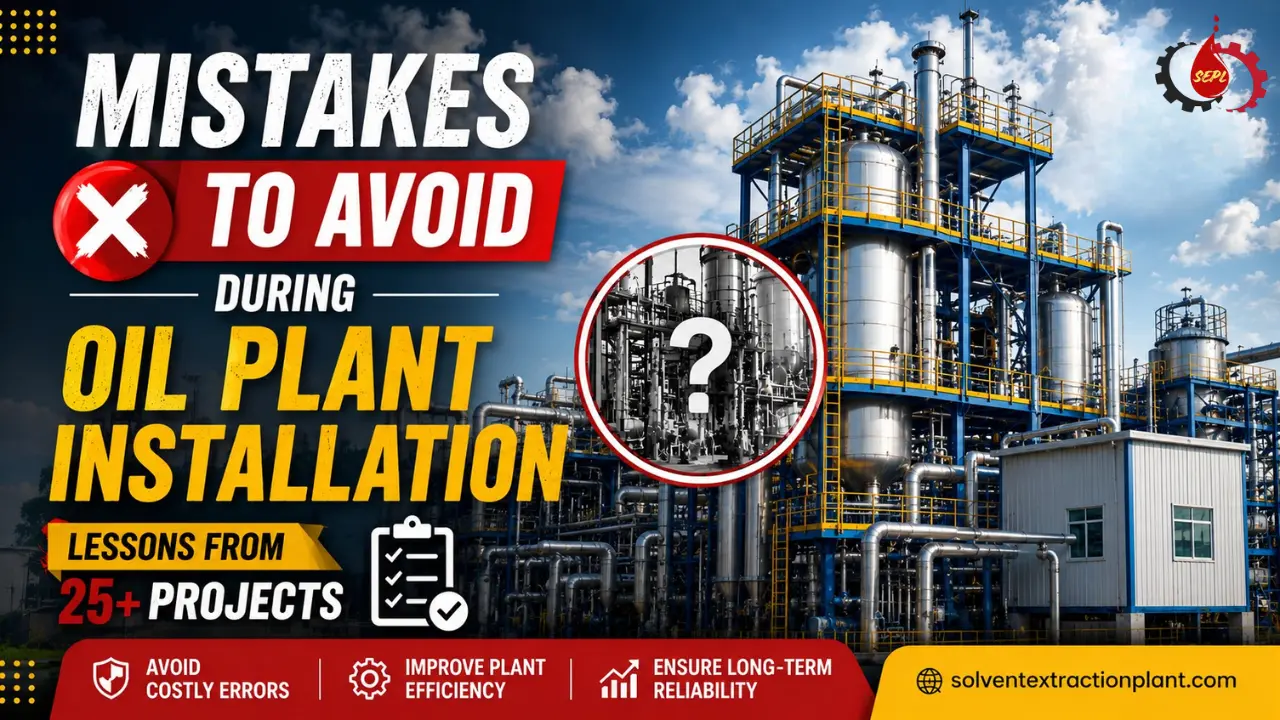
Installing an oil processing plant is one of the most significant capital decisions a business owner can make. Whether you are setting up a 50 TPD solvent extraction unit or a 500 TPD edible oil refinery, the installation phase is where projects either succeed or spiral into delays, cost overruns, and underperformance.
At Super Techno Engineers, we have designed, manufactured, and commissioned over 25 oil processing plants across India, Tanzania, Zambia, and other international markets. Along the way, we have seen the same oil plant installation mistakes repeat themselves, often costing clients lakhs of rupees and months of lost production time.
This oil plant installation guide is written from real project experience. If you are planning a new plant or evaluating a turnkey partner, read this before you begin.
Mistake #1 – Skipping a Proper Site Assessment
One of the most common and costly oil plant installation mistakes is treating site assessment as a formality. Many buyers finalize equipment before even evaluating the plot.
A proper site survey must cover:
- Civil foundation requirements for heavy equipment like extractors, DT systems, and refinery vessels
- Utility availability – steam, water supply, power load, and drainage
- Road access for raw material inward and oil outward logistics
- Soil bearing capacity especially in African or semi-arid project sites
- Wind direction and ventilation layout for hexane safety compliance
Skipping this step leads to expensive civil rework, equipment relocation mid-installation, and in some cases, non-compliance with local safety regulations.
Lesson: Always begin with a formal site survey. Ask your turnkey oil plant manufacturer to conduct a techno-commercial site assessment before order finalization.
Mistake #2 – Choosing Capacity Based on Budget, Not Demand
Undersizing and oversizing are both traps. We have seen clients install a 50 TPD plant expecting to scale quickly, only to find themselves running two shifts within six months with no room to expand. We have equally seen oversized 300 TPD plants running at 40% utilization for years.
The right capacity is determined by:
- Current and projected raw material availability (cottonseed, soybean, mustard, sunflower, etc.)
- Local and export market demand
- Seasonal supply patterns of oilseeds
- Budget for working capital alongside capex
For a complete solvent extraction plant, the capacity range spans 50 TPD to 2000 TPD. The correct selection needs honest demand-side analysis, not just what fits the budget today.
Lesson: Invest time in a realistic feasibility study. A good oil refinery project consultant will model demand before recommending capacity.
Mistake #3 – Ignoring Solvent Handling and Safety Infrastructure
This is the most dangerous mistake on this list and, unfortunately, not a rare one.
Hexane, the primary solvent used in solvent extraction plants, is highly flammable and volatile. Many buyers focus entirely on extraction efficiency and oil yield during vendor discussions, while safety infrastructure receives minimal attention until the plant is already being installed.
Critical safety requirements that are often overlooked:
- Explosion-proof electrical fittings in the extraction hall
- Negative pressure systems to prevent hexane vapor escape
- Adequate ventilation and exhaust ducting
- Solvent storage tank placement and bunding design
- Fire suppression and emergency shutdown systems
- Regular pressure and leak testing of the miscella circuit
Our solvent extraction plant spares and equipment – including rotary valves, DT trays, and miscella pumps – are all designed to minimize solvent exposure risks. But the surrounding safety infrastructure must be planned from day one.
Lesson: Treat hexane safety infrastructure as a non-negotiable part of your oil mill installation process, not an optional add-on.
Mistake #4 – Selecting Vendors on Price Alone
In B2B industrial procurement, price is always a factor. But in oil plant installation, the lowest quote is almost never the lowest total cost.
We regularly work with clients who come to us after a cheaper vendor has delivered equipment that:
- Does not match the promised oil recovery percentage
- Uses substandard steel grades that corrode within two to three years
- Lacks CE or ISO certification, creating compliance issues for export markets
- Has no local service support, leading to weeks of downtime when breakdowns occur
What to Compare When Evaluating Vendors
| Evaluation Parameter | What to Check |
|---|---|
| Certifications | ISO 9001:2015, ISO 14001:2015, CE Marking, GMP |
| Project Track Record | Number of commissioned plants, client references |
| After-Sales Support | Spare parts availability, response time, on-site visits |
| Manufacturing Model | 100% in-house vs. subcontracted components |
| Capacity Range | Can they serve your scale: 50 TPD to 2000 TPD? |
| Export Experience | Projects outside India, knowledge of local regulations |
Explore our turnkey oil plant manufacturer Post to understand what a full-service project scope looks like and what you should be comparing across vendors.
Lesson: Total cost of ownership – including spares, downtime, energy consumption, and oil yield – matters far more than the purchase price.
Mistake #5 – Poor Equipment Layout Planning
Equipment layout is not just an aesthetic or space management decision. It directly impacts:
- Operator safety and movement between process stages
- Maintenance access for routine servicing and emergency repairs
- Process flow efficiency and miscella routing distances
- Future expansion headroom
In many projects we have reviewed, clients or their local contractors had placed the desolventization toaster (DTDC) too close to the extraction hall, creating both a fire risk and an operational bottleneck. Similarly, placing material handling equipment such as screw conveyors and bucket elevators without considering throughput direction adds unnecessary energy load and creates grain spillage hotspots.
A proper plant layout drawing with detailed elevation views, maintenance corridors, and utility routing must be finalized and approved before civil work begins.
Lesson: Invest in detailed 2D and 3D plant layout drawings before any foundation work starts.
Mistake #6 – Underestimating Seed Preparation Requirements
Many buyers treat seed preparation as a minor upstream step and allocate minimal budget or space to it. This is a significant common oil plant mistake.
Inadequate seed preparation – poor cleaning, incorrect cracking, or improper flaking thickness – directly reduces oil extraction efficiency. If oilseed flakes are too thick, solvent penetration is limited. If they are too thin or powdery, they clog the extractor and increase meal carryover in miscella.
Proper seed preparatory infrastructure must include:
- Scalper and destoner for cleaning
- Cracker rolls calibrated for seed type and size
- Flaking mills with precise gap control
- Conditioning systems for moisture and temperature management
Our plant design process always begins with oilseed characterization – moisture content, oil content, hull percentage, and density – before recommending seed prep equipment specifications.
Lesson: Seed preparation quality determines extraction quality. Do not underinvest in this stage.
Mistake #7 – Neglecting the Edible Oil Refinery Stage in Overall Planning
A common planning gap we see is when clients plan their solvent extraction plant in detail but treat the edible oil refinery plant as a phase two afterthought.
This creates serious problems:
- Space is not left for refinery equipment in the original plant layout
- Utility sizing (steam, power) is calculated only for extraction, not refining
- Civil foundations are not built to accommodate neutralizer, bleacher, and deodorizer loads
If your end product requires refined oil – whether for retail, food service, or export – the refinery section must be planned as part of the same project from day one.
Proper refinery planning should also include sourcing quality edible oil refinery spares to ensure reliable operation post-commissioning. Learn more here: How to Choose the Right Edible Oil Refinery Spares Manufacturer in India
Lesson: Always plan extraction and refining as one integrated edible oil plant setup, not two separate projects.
Mistake #8 – Skipping Commissioning Trials and Operator Training
This is the final and often the most underestimated mistake. Many clients push for a fast handover, skipping or cutting short the commissioning and training phase.
Proper commissioning for a solvent extraction and refinery plant should include:
- Dry run of all mechanical systems and conveyor interlocks
- Solvent charging and first extraction trial runs
- Miscella and oil quality testing at each process stage
- Adjustment of steam pressures, temperature profiles, and solvent-to-solid ratios
- Operator training on startup, normal operation, and emergency shutdown procedures
A plant that is handed over without thorough commissioning trials will inevitably face early operational failures, often within the first 30 to 60 days of production.
Lesson: Do not treat commissioning as a box-ticking exercise. Insist on full trial runs with your engineering team present, and ensure operators are fully trained before your vendor team leaves the site.
Quick Reference: All 8 Oil Plant Installation Mistakes at a Glance
| # | Mistake | Root Cause | Impact |
|---|---|---|---|
| 1 | Skipping site assessment | Rush to order equipment | Civil rework, regulatory non-compliance |
| 2 | Wrong capacity selection | Budget-driven decisions | Under/overproduction, poor ROI |
| 3 | Ignoring hexane safety | Focus only on yield | Fire risk, legal liability |
| 4 | Choosing cheapest vendor | Short-term cost thinking | Frequent breakdowns, low oil yield |
| 5 | Poor layout planning | No engineering oversight | Safety hazards, high maintenance cost |
| 6 | Weak seed preparation | Underestimated importance | Lower extraction efficiency |
| 7 | No refinery planning upfront | Phased thinking | Space shortage, utility mismatch |
| 8 | Skipping commissioning | Urgency to go live | Early failures, undertrained operators |
Frequently Asked Questions
Q1. What is the most common oil plant installation mistake in India?
The most common mistake is finalizing equipment and placing orders before conducting a proper site survey. Many clients skip or rush through the civil and utility assessment phase, which leads to expensive rework once installation begins. A thorough site assessment covering soil bearing capacity, utility connections, and layout planning is essential before any purchase decision.
Q2. How long does oil plant installation typically take?
For a 50 to 200 TPD solvent extraction plant, the typical timeline from order confirmation to commissioning is 4 to 6 months. Larger plants of 300 TPD and above generally require 6 to 10 months. Delays most commonly occur due to incomplete site preparation, civil work delays, or late utility connections on the client side.
Q3. What certifications should I check before selecting an oil plant manufacturer?
Look for ISO 9001:2015 for quality management, ISO 14001:2015 for environmental compliance, CE Marking if you are exporting to European markets, and GMP certification for food-grade oil production. These are not just paperwork – they reflect whether the manufacturer’s processes and equipment meet international engineering and safety standards.
Q4. Is it necessary to plan the edible oil refinery along with the solvent extraction plant?
Yes. If your business model involves selling refined edible oil, planning extraction and refining together from day one avoids serious problems later – including insufficient space, undertailored utility systems, and mismatched civil foundations. Treating the refinery as a separate future phase almost always creates costly rework.
Q5. Why is operator training important during commissioning?
Operators who understand the plant’s startup sequence, normal operating parameters, and emergency shutdown procedures prevent the majority of early-stage failures. Most production incidents in the first 60 days after commissioning are linked to operator error, not equipment failure. Proper training during commissioning is therefore as important as the equipment itself.
Q6. What are the hexane safety requirements for a solvent extraction plant?
Key hexane safety requirements include explosion-proof electrical fittings throughout the extraction hall, a negative pressure system to contain vapors, proper ventilation and exhaust ducting, bunded solvent storage tanks with adequate separation from the plant building, fire suppression systems, and regular pressure testing of the miscella circuit. These must be built into the plant design, not added as an afterthought.
Q7. Can Super Techno Engineers handle international oil plant projects?
Yes. Super Techno Engineers has successfully commissioned turnkey oil processing plants in Tanzania, Zambia, and other international markets. Our project scope covers everything from initial site survey and engineering design to equipment manufacturing, installation, commissioning, and operator training, regardless of location.
Final Thoughts
Oil plant installation is complex, capital-intensive, and unforgiving of shortcuts. The eight mistakes outlined above have been observed directly across projects spanning India, Africa, and the Middle East. In almost every case, they were preventable with better planning, the right partner, and a more complete understanding of the full project scope.
At Super Techno Engineers, our turnkey project model is designed specifically to eliminate these gaps – from the initial site survey and layout design through equipment manufacturing, installation, commissioning, and post-handover support.
If you are planning a new solvent extraction plant, edible oil refinery, or cattle feed plant installation, speak with our engineering team before you finalize any decisions.
Contact Super Techno Engineers for a free project consultation.