
For industrial processors, engineers, and procurement teams evaluating shea oil production capacity — understanding the complete solvent extraction process is not optional. It is the foundation of every yield, quality, and cost decision your plant will make.
45–55%Oil content in sheanuts
>97%Oil recovery via solvent
~68°CHexane boiling point
<1%Residual oil in spent meal
What Is Sheanut Solvent Extraction?
Sheanut solvent extraction is an industrial process that uses a chemical solvent — most commonly n-hexane — to dissolve and recover oil from shea kernels. Unlike mechanical pressing, which relies on physical force to squeeze oil from the nut, solvent extraction works at the molecular level: the solvent permeates the cell structure of the processed kernel, dissolves the triglyceride oil, and carries it out as a solution called miscella.
In a full-scale solvent extraction plant, solvent extraction is almost always deployed as the second stage, following a mechanical pre-press. The pre-press removes the bulk of the oil; the solvent extraction unit recovers the remaining 15–20% that mechanical force alone cannot reach. Together, the two stages achieve an overall oil recovery rate that consistently exceeds 97% of total available oil in the feedstock.
This is also referred to as:
- Shea nut oil extraction — the general term for the industrial separation process
- Shea oil extraction process — encompassing pre-treatment, solvent contact, desolventising, and distillation
- Oil solvent extraction process — the engineering term covering the full solvent-based recovery cycle
- Shea nut oil manufacturing — the broader commercial context from raw nut to marketable crude oil
Understanding what differentiates each term matters when specifying equipment, writing procurement briefs, or evaluating plant proposals — which is why we treat them precisely throughout this guide.
Why Mechanical Pressing Alone Is Not Sufficient at Industrial Scale
Expeller pressing has been the standard method for smaller-scale shea oil production for decades. At artisanal or cottage-industry volumes, it is a practical, low-capital solution. But at industrial throughput — 50 tonnes per day and above — its limitations become economically significant.
Here is the core problem: expeller presses typically leave 8–15% residual oil in the spent cake. On a 100 TPD plant processing sheanuts with 50% oil content, that means 4 to 7.5 tonnes of oil exits in the waste stream every single day. At any market price for shea oil, that is a substantial, recoverable revenue loss.
A plant processing 100 tonnes of sheanuts per day with 12% residual oil in press cake is losing approximately 6 tonnes of recoverable shea oil daily — before accounting for refining margins. Solvent extraction reduces that loss to under 1 tonne per day.
Beyond yield, mechanical pressing imposes limitations on throughput consistency, energy intensity per unit of oil produced, and the ability to process lower-quality or variable-moisture feedstock without significant oil quality degradation. Industrial shea nut extraction technology addresses each of these constraints systematically.
Solvent Extraction vs. Cold Press vs. Supercritical CO₂: Key Differences
Choosing the right extraction method is a capital and operational decision that defines plant economics for decades. Here is a direct comparison of the three primary shea oil extraction technologies deployed at scale:
| Factor | Solvent extraction | Mechanical / cold press | Supercritical CO₂ |
| Oil recovery rate | 95–99% | 80–90% | 92–97% |
| Throughput suitability | 50–1,000+ TPD | 1–50 TPD | 0.5–5 TPD |
| Capital investment | High | Moderate | Very high |
| Operating cost / tonne | Low at scale | Moderate | Very high |
| Crude oil quality | Requires full refining | Minimal refining needed | Premium, minimal refining |
| Unsaponifiables retained | Partially reduced post-refining | Well retained | Fully retained |
| Regulatory complexity | High (ATEX, solvent limits) | Low | Moderate |
| Scalability | Excellent | Limited | Not viable at commodity scale |
For industrial shea oil manufacturing at commercial volumes, solvent extraction remains the only method that delivers both the throughput capacity and the unit economics required. This guide focuses on the solvent extraction route as implemented in a full-scale shea nut processing plant.
How the Shea Oil Extraction Process Actually Works: The Technical Mechanism
Before walking through each plant stage, it is worth understanding the underlying physics. Solvent extraction operates on the principle of differential solubility: n-hexane dissolves non-polar triglyceride oils readily, while leaving proteins, fibres, and moisture largely unaffected.
When hexane contacts prepared shea kernel material, it diffuses through the cell walls of the flaked meal, contacts the oil droplets held within the cell structure, and forms a homogeneous solution (miscella). The rate of extraction depends on four primary variables:
Contact surface area
Thinner flakes expose more cell surface to solvent. Standard flake thickness targets 0.25–0.35 mm for optimal extraction kinetics.
Solvent-to-meal ratio
Higher ratios improve extraction completeness but increase energy costs for solvent recovery. Counter-current design optimises this balance.
Contact temperature
Extraction at 55–65°C improves oil solubility in hexane and reduces viscosity. Temperatures above 70°C risk hexane vapour pressure issues and oil degradation.
Residence time
Adequate contact time — 45 to 90 minutes in a continuous extractor ensures near-complete oil dissolution from the meal matrix.
The counter-current flow principle is central to extraction efficiency: fresh solvent always contacts the most oil-depleted meal at the exit end of the extractor, ensuring maximum driving force throughout the system.
Counter-current extraction allows near-complete oil recovery with a solvent-to-meal ratio of 0.8–1.2:1 by weight versus 3–5:1 for simple batch immersion. It is the engineering principle that makes industrial-scale shea nut oil extraction economically viable.
Core Performance Factors in a Shea Nut Solvent Extraction Plant
Plant performance in shea oil solvent extraction is determined by six interdependent variables. Engineers and plant managers should treat these as the primary levers for optimisation:
1> Feedstock preparation quality
The condition of shea kernels entering the extraction system sets the ceiling on everything downstream. Moisture content above 8%, inadequate hull separation, or inconsistent flake thickness all reduce extraction efficiency and increase solvent consumption. Feedstock preparation — including all upstream material handling equipment from intake conveyors to kernel elevators is not a support function. It is a primary extraction variable.
2>Extractor design and residence time
The choice between loop extractor, belt extractor, and drag-chain extractor configurations affects capacity, maintenance frequency, and extraction efficiency. For sheanut processing plants above 100 TPD, loop extractors offer the best combination of throughput, solvent economy, and maintainability. Rotary valves, miscella pumps, and solvent heaters — all critical solvent extraction plant spares must be specified and stocked from commissioning.
3>Desolventiser-toaster (DT) performance
Residual hexane in the spent meal is a regulatory and commercial issue. DT performance determines both meal quality critical if the meal is sold as animal feed or pelletised using a pellet mill for biomass or feed applications and solvent recovery efficiency. Poor DT operation is one of the most common causes of excessive solvent losses and regulatory non-compliance in operating plants.
4>Solvent recovery and recycling efficiency
Hexane is both the largest variable cost input and the primary safety and environmental liability in the plant. A well-engineered distillation and condensation loop should recover more than 99.8% of solvent per cycle. Precise valves and instrumentation including pressure gauges, control valves, and level indicators are essential to maintaining accurate solvent inventory control and preventing undetected losses.
5>Energy integration and steam management
Steam is consumed throughout the extraction plant — in conditioning, the DT, evaporation, and stripping. Plants that integrate waste heat recovery between the DT overhead vapours and the conditioning and pre-press sections can reduce net steam consumption by 20–30%, directly impacting operating cost per tonne of shea oil produced.
6>Mineral oil absorber and vent gas management
Hexane vapour exits the plant through DT vents, condenser non-condensables, and storage tank breathing. A properly sized and maintained mineral oil absorber is essential for both regulatory compliance and solvent loss control. Many plants underestimate the contribution of vent losses to total solvent consumption — a properly instrumented vent system addresses this directly.
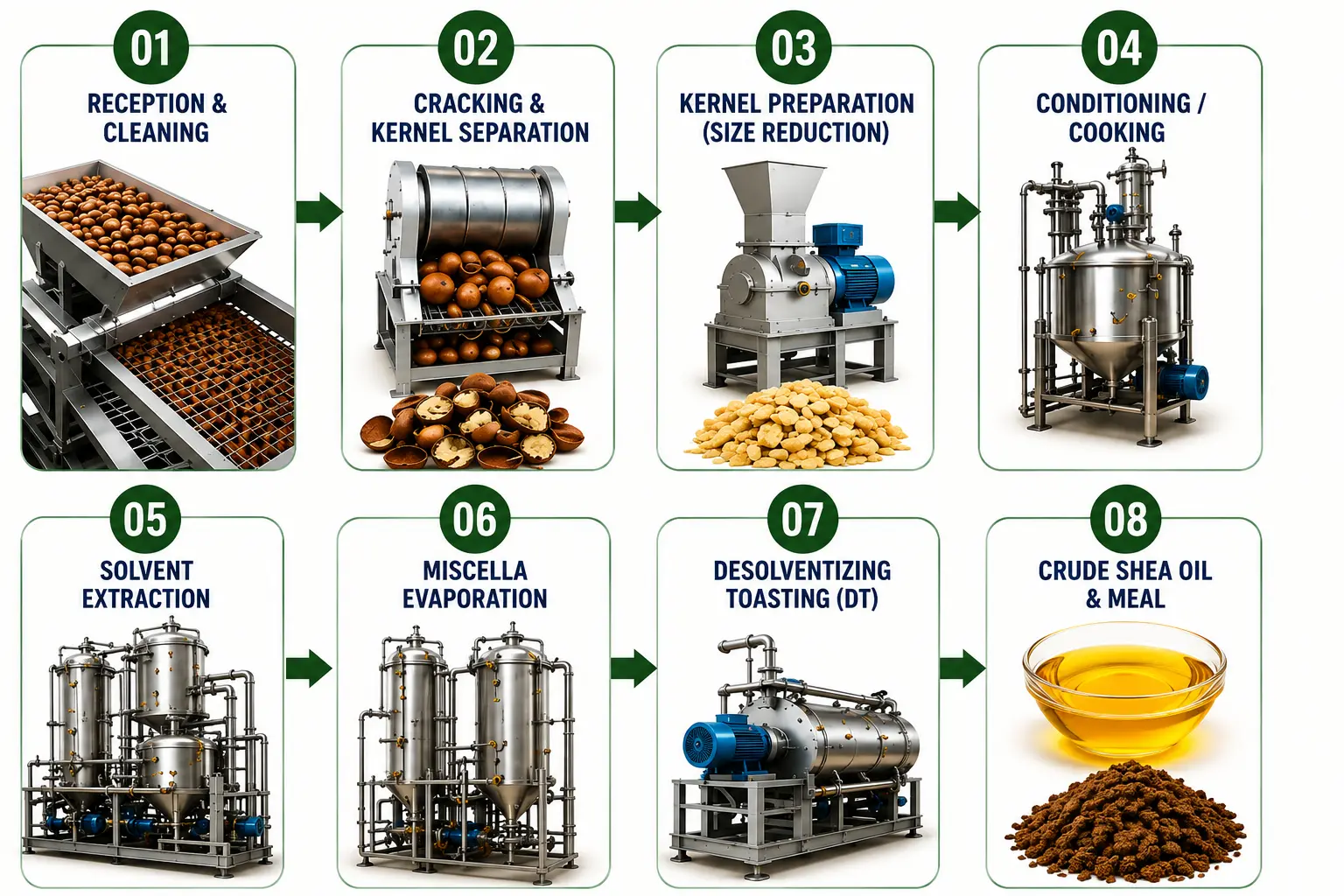
Step-by-Step: Complete Sheanut Solvent Extraction Plant Process
Raw sheanuts→Cleaning→Cracking & hulling→Conditioning→Flaking→Pre-pressing→Solvent extraction→Desolventising→Distillation→Crude shea oil
Stage 1 — Raw material receiving and cleaning
Incoming sheanuts are weighed, sampled, and assessed for moisture content, kernel-to-hull ratio, and free fatty acid profile before entering the processing line. Primary cleaning removes extraneous matter using rotary drum screens and destoning equipment; secondary aspiration removes light impurities, including dust and leaf fragments. Moisture content above 8% is flagged for pre-drying before further processing.
The reliability of this intake stage depends directly on the material handling equipment deployed bucket elevators, drag chain conveyors, and screw conveyors that move sheanuts from intake hoppers through cleaning systems and into the processing line. Equipment failures at this stage create bottlenecks that cascade through every downstream unit.
Stage 2 — Cracking, hulling, and kernel separation
Cleaned sheanuts pass through centrifugal or impact crackers that fracture the hard outer shell without damaging the kernel inside. The cracked mixture is separated by aspiration and gravity separation; target hull content in the clean kernel stream is below 3% by weight. Separated shells are conveyed to biomass boilers, where they generate a substantial portion of the steam required by the plant — reducing purchased energy costs by 30–60%.
Desolventised shea meal from the extraction process is also a valuable co-product. When processed through a pellet mill, the spent meal can be converted into uniform pellets suitable for animal feed or biomass fuel adding a measurable revenue stream to the plant’s output portfolio.
Stage 3 — Conditioning
Clean kernels enter conditioning vessels where they are heated with direct or indirect steam to 65–80°C and adjusted to 10–12% moisture. The purpose of conditioning is to soften the cell structure of the kernel, making it more amenable to plastic deformation in the flaking rolls. Properly conditioned kernels produce uniform, coherent flakes with minimal fines generation directly improving extraction efficiency in the downstream extractor.
Stage 4 — Flaking
Conditioned kernels pass between precision-machined, counter-rotating flaking rolls with a controlled gap of 0.25–0.35 mm. The rolls crush the kernel into thin, flat flakes that dramatically increase the surface area exposed to hexane during extraction. Flake thickness control is critical: a 10% increase in average flake thickness can reduce extraction efficiency by 2–4 percentage points. Roll gap maintenance and regular wear monitoring are essential plant routines.
Stage 5 — Pre-pressing (expeller stage)
Flaked material passes through continuous screw presses (expellers) that apply mechanical pressure to extract the majority of the oil reducing residual oil in the press cake to 15–20%. Press oil, typically of higher quality than solvent-extracted oil, is collected separately and may be processed as premium crude or blended post-distillation. The condition of press cake entering the extractor particle size, residual oil content, and temperature directly affects both extraction efficiency and extractor operability.
Stage 6 — Solvent extraction
Press cake enters the continuous extractor, where it is contacted with n-hexane in a counter-current arrangement. As the cake moves through the extractor, it encounters increasingly fresh solvent, which dissolves residual oil to form miscella. The spent meal containing less than 1% residual oil exits the extractor and is conveyed to the DT, while the rich miscella flows through a filtration stage before entering the distillation train. Extraction temperature is maintained at 55–65°C, with a total residence time of 45–90 minutes.
The extraction stage is where plant economics are won or lost. A difference of 0.5 percentage points in residual oil — 0.8% versus 1.3% translates to hundreds of tonnes of additional oil recovery per year on a 200 TPD plant, at zero additional feedstock cost.
Stage 7 — Desolventising and toasting (DT)
Solvent-wet spent meal exits the extractor containing 25–35% hexane by weight. In the desolventiser-toaster (DT) a key unit available as part of SuperTechno’s solvent extraction plant spares and equipment range the meal is treated with direct steam injection and indirect steam heating to reduce hexane residuals to below 500 ppm. DT vapours pass to the condenser for hexane recovery; non-condensable gases go to the mineral oil absorber before atmospheric discharge.
Stage 8 — Miscella distillation and solvent recovery
Rich miscella enters a two-stage evaporation and distillation system. In the first-stage evaporator, the bulk of the hexane is evaporated under mild vacuum and returned to the solvent loop. The concentrated miscella passes to the second-stage evaporator, then to a steam stripping column where open steam under vacuum strips the final hexane traces. Crude shea oil exits the stripper at less than 50 ppm residual hexane.
Accurate pressure control throughout the distillation train is non-negotiable. Industrial-grade valves and instrumentation, including vacuum control valves, pressure gauges, and temperature transmitters, are what distinguish a stable, low-loss distillation operation from one that consistently underperforms on solvent consumption.
Stage 9 — Crude oil storage and quality analysis
Crude shea oil from the distillation unit is sampled and tested before release to storage. Key quality parameters include: free fatty acid content (1–5% as oleic), peroxide value, colour (Lovibond), moisture and volatile matter, and insoluble impurities. Storage tanks are heated (shea oil solidifies below approximately 28–35°C) and maintained under nitrogen blanket to prevent oxidation during storage.
Key Equipment in a Shea Nut Solvent Extraction Plant
| Equipment | Primary function | Critical parameter |
| Rotary screen & destoner | Removes foreign matter from raw nuts | Screen aperture size |
| Bucket elevator & drag conveyor | Material handling from intake through cleaning | Capacity & uptime |
| Impact / centrifugal cracker | Fractures shell without kernel damage | Kernel integrity rate (>92%) |
| Aspirator & gravity separator | Separates hull from kernel by density | Hull content in kernel stream (<3%) |
| Conditioning vessel | Steam-heats kernels to optimise flakability | Exit temperature & moisture |
| Flaking rolls | Crushes kernels to 0.25–0.35 mm flakes | Roll gap uniformity |
| Screw press / expeller | Mechanical pre-extraction of bulk oil | Residual oil in cake (15–20%) |
| Loop / belt extractor | Counter-current hexane contact with press cake | Residual oil in spent meal (<1%) |
| Miscella filter | Removes meal fines from miscella pre-distillation | Particle size in filtered miscella |
| Desolventiser-toaster (DT) | Removes hexane from spent meal via steam — see extraction plant spares | Residual hexane in meal (<500 ppm) |
| Evaporators & steam stripper | Concentrates miscella; yields crude shea oil | Hexane in crude oil (<50 ppm) |
| Condenser train | Recovers hexane vapour from DT, evaporators, stripper | Cooling water temperature & flow |
| Control valves & pressure gauges | Precise process control — see valves and instrumentation | Calibration frequency |
| Mineral oil absorber | Captures trace hexane from vent gases | Hexane slip to atmosphere |
| Pellet mill | Converts spent meal to feed / biomass pellets — see pellet mill solutions | Die specification & throughput |
Technical Setup: Solvent Selection and Plant Safety Requirements
N-hexane remains the dominant solvent in industrial shea nut oil manufacturing globally. Its combination of low boiling point (68°C), high selectivity for triglyceride oils, low water miscibility, and established recovery technology makes it the reference solvent against which alternatives are benchmarked.
| Solvent | Key properties | Suitability | Limitations |
| n-Hexane | BP 68°C, low polarity, excellent oil selectivity | Industrial standard | Flammable; strict residual limits |
| Isohexane | BP 60°C, similar to n-hexane | EU preferred | Marginally higher cost |
| Ethanol | Polar; co-extracts phospholipids | Specialty use | Requires complex downstream processing |
| Supercritical CO₂ | No residual solvent; premium quality | Premium niche | Not viable at commodity scale |
| Propane / butane | Low temperature extraction | Limited use | High flammability; regulatory complexity |
Because hexane has a flash point of –22°C, the entire extraction plant is classified as a hazardous area. Reliable industrial valves and instrumentation, including explosion-proof pressure gauges, safety relief valves, and continuous vapour monitoring instruments are not optional components. They are the engineering backbone of safe plant operation. Key safety requirements include:
- Full ATEX / IECEx zone classification across extraction, DT, and solvent storage areas
- Explosion-proof motors, instrumentation, and electrical fittings throughout classified zones
- Continuous hexane vapour detection with graduated alarm and automatic shutdown setpoints
- Nitrogen blanketing on miscella tanks, hexane storage, and extractor inlet/outlet seals
- Emergency dump system for rapid drainage of hexane to a sealed sump in the event of fire or explosion risk
- Closed-loop condensate recovery to eliminate open venting of hexane to atmosphere
- Periodic third-party safety audits and pressure testing of all solvent-containing equipment
Quality and Compliance Standards in Industrial Shea Oil Extraction
Buyers of crude shea oil, whether for cosmetics, food ingredient, or pharmaceutical use evaluate suppliers against increasingly stringent quality and compliance frameworks. A shea nut processing plant that cannot demonstrate systematic quality management will find its market access narrowing. The four dimensions of quality assurance that determine market position are:
1> Process documentation and traceability
Every batch of crude shea oil should be traceable to its source nut consignment, processing date, extraction parameters, and analytical results. Full batch traceability is a baseline requirement for food and cosmetic market access and is increasingly demanded by sustainability-conscious buyers in export markets.
2> Solvent residual control
EU Regulation EC 1881/2006 sets maximum hexane residuals in food-grade vegetable oils at 1 mg/kg (1 ppm). Cosmetic-grade buyers typically require residuals below 5 ppm. Systematic monitoring of stripper performance supported by well-maintained refinery spares including pressure leaf filters and heat exchangers, is the primary control mechanism.
3> Third-party certification
ISO 22000, FSSC 22000, or HACCP certification signals to buyers that the plant operates within a documented food safety management system. For organic-certified shea oil, additional requirements around solvent type, cleaning protocols, and segregation apply. GMP certification is increasingly required for pharmaceutical-grade shea oil supply.
4> Environmental compliance reporting
Atmospheric hexane emissions, wastewater discharge, and solid waste management are subject to national and international environmental regulations. Plants that invest in robust monitoring, reporting, and continuous improvement reduce regulatory risk and strengthen their position with ESG-focused buyers.
Yield and Performance Benchmarks
| Parameter | Typical range | World-class target |
| Residual oil in spent meal (% dry basis) | 0.8–1.5% | <0.8% |
| Overall oil recovery (% of total oil in nut) | 95–97% | >97% |
| Solvent consumption (litres per tonne of seed) | 1.0–2.5 L | <1.0 L |
| Hexane in crude oil (ppm) | 50–200 ppm | <30 ppm |
| Hexane in spent meal (ppm) | 200–500 ppm | <200 ppm |
| Steam consumption (kg per tonne seed) | 250–350 kg | <220 kg |
| Electricity consumption (kWh per tonne seed) | 30–45 kWh | <30 kWh |
| Plant availability (annual uptime) | 85–90% | >92% |
| Crude oil FFA content (% as oleic) | 1–5% | <2% (from quality feedstock) |
Downstream Processing: From Crude Shea Oil to Refined Product
Crude shea oil from the solvent extraction unit is an intermediate product. Its commercial value is fully realised after refining the process that removes phospholipids, free fatty acids, colour pigments, and odorants to produce refined shea oil or shea butter for cosmetic, food, and pharmaceutical end markets.
Crude shea oil→Degumming→Neutralisation→Bleaching→Deodorisation→Refined shea oil / butter
An edible oil refinery plant integrated with the extraction unit allows the processor to capture the full value chain from raw sheanut through to market-ready refined oil within a single facility. This vertical integration reduces intermediate handling costs and allows tighter control over final product quality and traceability.
Maintaining consistent output quality from the refinery requires reliable replacement components. Edible oil refinery spares, including pressure leaf filters, bleaching earth dosing systems, and heat exchanger bundles, should be stocked as part of the plant’s strategic spares inventory. Unplanned downtime in the refinery section is one of the most preventable causes of off-specification product and contract penalties.
A critical technical consideration for shea oil specifically: physical refining (using steam distillation for FFA removal) is generally preferred over chemical refining for shea oil destined for high-value cosmetic applications, as it better preserves the unsaponifiable fraction, the sterols and triterpene alcohols that justify premium pricing in formulation markets.
For shea oil projects targeting cosmetic active-ingredient markets, the choice of refining method can be as commercially significant as the extraction method itself. At SuperTechno, plant design integrates extraction and refinery specifications from the outset to ensure the final product meets buyer requirements without unnecessary processing losses.
Common Operational Mistakes to Avoid
Underestimating feedstock preparation as an extraction variable
The most common source of below-target extraction performance is not the extractor but inadequate flake quality due to worn roll surfaces, incorrect conditioner temperature, or high-moisture kernels. Feedstock preparation maintenance, including routine servicing of all upstream conveyors and elevators, should be treated as a primary extraction function.
Operating the DT outside specification
Inadequate DT performance, insufficient steam, blocked distribution nozzles, or excessive throughput relative to DT capacity results in high hexane residuals in the meal and elevated solvent losses. Many plants accept this as normal variance rather than investigating it as a fixable process deviation. Timely replacement of worn DT internals using manufacturer-specified extraction plant spares is the most cost-effective corrective action.
Ignoring solvent inventory tracking
Without systematic daily solvent inventory balances, slow leaks, seal failures, and increasing vent losses go undetected until they represent a significant economic and safety problem. Reliable valves and instrumentation for flow measurement, level sensing, and pressure monitoring make accurate daily mass balances practical and reliable.
Skipping pre-commissioning performance testing
New extraction plants are frequently commissioned without rigorous performance acceptance testing against contractual guarantees. Residual oil targets, solvent consumption figures, and throughput capacity should all be formally tested and documented at commissioning. Deficiencies identified at commissioning are substantially cheaper to resolve than those discovered after a year of suboptimal operation.
Delaying refinery integration planning
Many processors commission an extraction plant and plan the refinery as a later phase, only to find that civil, utility, and layout constraints make integration far more expensive post-construction. Designing the edible oil refinery plant alongside the extraction unit from the outset eliminates this problem and significantly reduces total project capital cost.
Frequently Asked Questions
Q.1 What is sheanut solvent extraction and how does it differ from cold pressing?
Sheanut solvent extraction uses n-hexane to dissolve and recover oil from shea kernels at the molecular level, achieving residual oil levels below 1% in spent meal. Cold pressing uses mechanical force only and typically leaves 8–15% residual oil in the cake. At industrial throughputs above 50 TPD, solvent extraction is economically superior due to significantly higher oil recovery and lower cost per tonne of oil produced.
Q.2 What solvent is used in industrial shea nut oil extraction?
N-hexane is the industry-standard solvent used in the vast majority of commercial shea oil processing plants. Isohexane is increasingly used in European plants. Alternative solvents, including ethanol and supercritical CO₂ are used in speciality applications but are not viable for commodity-scale industrial oil extraction.
Q.3 What is the typical oil recovery rate in a well-operated solvent extraction plant?
A well-designed solvent extraction plant achieves overall oil recovery of 95–99% of total oil present in the feedstock, with residual oil in spent meal below 1% on a dry basis. World-class plants target below 0.8% residual oil. Recovery rates below 95% typically indicate feedstock preparation problems, extractor performance issues, or both.
Q.4 What are the food-grade hexane residual limits for shea oil?
EU Regulation EC 1881/2006 sets a maximum hexane residual of 1 mg/kg (1 ppm) in food-grade vegetable oils. Cosmetic-grade buyers typically specify below 5 ppm. A properly operated steam stripping stage consistently achieves below 30–50 ppm, well within both limits, provided the stripper and associated instrumentation are maintained within specification.
Q.5 What safety standards apply to a shea oil solvent extraction plant?
The plant is classified as a hazardous area due to hexane flammability. Engineering must comply with ATEX, IECEx, or NEC zone classification standards, requiring explosion-proof electrical equipment, continuous vapour monitoring, nitrogen blanketing, and regular third-party safety audits. Precise valves and instrumentation rated for hazardous areas are a non-negotiable part of the safety-critical equipment inventory.
Q.6 Can shea spent meal be valorised as a commercial co-product?
Yes. Desolventised shea meal contains significant protein and fat residuals that make it suitable for animal feed. When processed through a pellet mill, it can be converted into uniform, commercially saleable pellets. Shea shell, generated at the cracking stage, is a reliable biomass fuel that can supply 30–60% of the plant’s steam requirements when fed to a biomass boiler.
Q.7 What is the role of the desolventiser-toaster in the extraction process?
The DT removes residual hexane from spent meal using direct steam injection and indirect heating. It is critical for both regulatory compliance (hexane residuals in meal) and solvent recovery efficiency. DT internals trays, steam distribution nozzles, and scraper mechanisms are wear items that should be maintained using manufacturer-specified extraction plant spares to maintain performance over the plant’s operating life.
Q.8 Should refinery integration be planned alongside the extraction plant?
Yes, and ideally designed simultaneously. An integrated edible oil refinery plant allows the processor to capture the full value from crude shea oil through to market-ready refined product, with shared utilities, optimised plant layout, and a single project management process. Delaying refinery planning until after the extraction plant is built consistently results in higher total capital cost and suboptimal integration between the two sections.
Conclusion
The sheanut solvent extraction plant process is a highly engineered, multi-stage industrial system where performance at each stage directly determines the economics of every tonne of shea oil produced. From feedstock preparation and flaking through counter-current extraction, desolventising, distillation, and crude oil quality management, every variable interacts, and every percentage point of recovery improvement compounds across thousands of operating hours.
For industrial buyers, project developers, and processing plant operators, the decision framework is clear: solvent extraction is the only route to the yield, throughput, and unit economics required for commercially viable large-scale shea nut oil manufacturing. And integrating extraction with a downstream edible oil refinery plant backed by a reliable supply of extraction plant spares, refinery spares, and process instrumentation is what separates plants that consistently hit their design specifications from those that do not.
At SuperTechno Engineers, we design, supply, and commission solvent extraction plants for shea and other oilseeds, with full process guarantees on residual oil, solvent consumption, and throughput capacity. If you are evaluating a new shea oil processing plant or looking to upgrade an existing operation, our engineering team is available to review your project requirements in detail.