
Introduction
Every bottle of clear, golden cooking oil on an Indian kitchen shelf has passed through a series of refining stages before it reaches the consumer. Among these, the bleaching process oil refinery stage plays a quiet but decisive role. It is the stage where color pigments, trace metals, soaps, and oxidation by-products are pulled out of the oil, setting the stage for a stable, good-looking, long-shelf-life final product.
For plant operators, refinery engineers, and businesses evaluating refining equipment, understanding exactly how bleaching works (not just that it happens) makes the difference between an efficient plant and one that wastes clay, time, and oil quality. This guide walks through the bleaching process oil refinery setups step by step, explains the science of adsorption, and compares it with the other stages of vegetable oil refining. At Super Techno Engineers, we design and build bleaching and refining systems around exactly these parameters, so this breakdown reflects real plant practice rather than just theory.
What Is the Bleaching Process in an Oil Refinery?
The bleaching process oil refinery stage is the third major step of vegetable oil refining, following degumming and neutralization, and preceding deodorization. Its core purpose is to remove:
- Natural color pigments (chlorophyll, carotenoids)
- Residual soaps left over from neutralization
- Trace metals (iron, copper) that accelerate oxidation
- Oxidation products, peroxides, and secondary oxidation compounds
- Any remaining phospholipids or gums
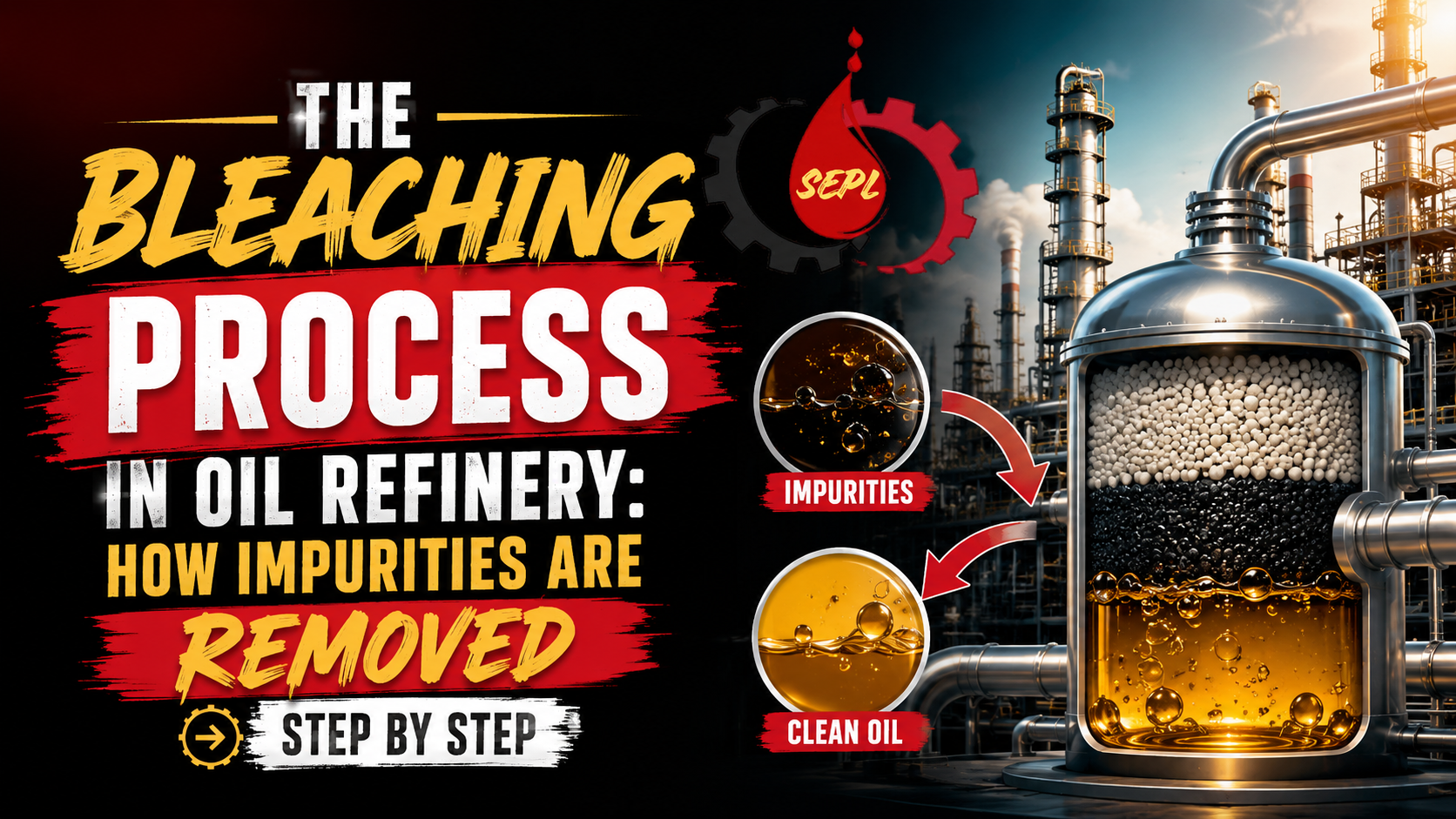
This is achieved primarily through adsorption, using specially prepared bleaching earth or activated clay, rather than through chemical reaction. The oil is heated, mixed thoroughly with the clay under vacuum, held for a set contact time, and then filtered to separate the spent clay from the now lighter, cleaner oil.
Why the Bleaching Stage Matters
Skipping or poorly executing bleaching has consequences that show up much later in the product’s life:
- Color stability: Unremoved pigments darken over time, especially under heat during deodorization.
- Oxidative stability: Trace metals left in the oil act as catalysts for rancidity, shortening shelf life.
- Flavor and odor: Oxidation products carried forward affect the final taste and smell of the oil.
- Downstream equipment protection: Impurities that reach the deodorizer can foul heating coils and packing.
In short, getting the bleaching process oil refinery stage right is not a cosmetic step. It directly determines how the oil performs in storage, transport, and on the shelf, which is why exporters and quality-focused refiners treat it as a critical control point rather than a routine formality.
Step-by-Step Breakdown of the Bleaching Process
Step 1: Oil Preheating
Neutralized and dried oil is fed into the bleacher vessel and heated using thermic fluid or steam coils, typically to a range of 100°C to 130°C, depending on the oil type. Correct temperature is essential: too low, and clay adsorption efficiency drops; too high, and the oil risks thermal degradation or oxidation.
Step 2: Vacuum Application
Bleaching is almost always carried out under vacuum. This serves two purposes: it prevents oxidation of the hot oil by limiting oxygen contact, and it helps remove moisture that would otherwise interfere with clay adsorption.
Step 3: Bleaching Clay Dosing
Activated bleaching earth (or a blend of activated and natural clay) is dosed into the oil, usually as a percentage of oil weight, commonly between 0.5% and 2%, adjusted based on the oil’s initial color and the target color specification. Dosing is often done through a slurry or a metered dry-feed system to ensure even distribution.
Step 4: Agitation and Contact Time
The oil-clay mixture is continuously agitated to keep the clay particles suspended and in maximum contact with the oil. Contact time typically ranges from 20 to 30 minutes, though this varies by clay type, oil viscosity, and target color reduction. Longer contact time is not always better: over-bleaching can strip beneficial compounds like tocopherols.
Step 5: Adsorption of Impurities
This is the chemical heart of the process. The porous surface of the clay attracts and binds:
- Color pigments through polar/surface interactions
- Residual soaps and phospholipids
- Trace metal ions
- Oxidation by-products
The efficiency of this stage depends heavily on the clay’s surface area, porosity, and acidity, factors covered in more detail below.
Step 6: Filtration
Once adsorption is complete, the oil-clay slurry is passed through filtration equipment to separate the spent clay (now loaded with impurities) from the clean oil. Two common filtration methods are used:
- Plate and Frame Filter Presses: Conventional, cost-effective, widely used in mid-sized plants.
- Vertical Pressure Leaf Filters: Enclosed, more automated, better suited for continuous or high-capacity operations with minimal oil exposure to air.
Step 7: Storage of Bleached Oil
The filtered, bleached oil is transferred to intermediate storage tanks (often under nitrogen blanketing to prevent re-oxidation) before moving to the deodorization stage.
Types of Bleaching Clay Used in Oil Refineries
Not all bleaching earth performs the same. Selecting the right type is one of the most consequential decisions in the bleaching process in oil refinery operations.
| Clay Type | Composition | Adsorption Capacity | Typical Use Case | Relative Cost |
| Natural Bentonite Clay | Untreated calcium/sodium bentonite | Moderate | Lightly colored oils, cost-sensitive plants | Low |
| Acid-Activated Clay | Bentonite treated with sulfuric/hydrochloric acid | High | Palm oil, soybean oil with heavy pigmentation | Medium-High |
| Attapulgite (Fuller’s Earth) | Natural clay mineral, less acidic | Low-Moderate | Mild refining, polishing stage | Low |
| Synthetic Silica-Based Adsorbents | Amorphous silica | High (selective) | Removing soaps and phospholipids specifically | High |
| Carbon-Blended Bleaching Earth | Clay + activated carbon | Very High | Oils with strong pigments or contaminants | High |
Choosing the correct clay isn’t just about cost: using an under-powered clay to save money often leads to higher dosage requirements overall, more oil loss (oil retained in spent clay), and inconsistent color results batch to batch.
Key Factors That Affect Bleaching Efficiency
Several interconnected variables determine how effective the bleaching process in oil refinery equipment will be:
- Clay selection and activation level: Activated clays adsorb far more efficiently than natural, non-activated ones.
- pH and moisture content of the clay: Excess moisture in the clay reduces its adsorption capacity.
- Surface area and porosity: Higher surface area allows more contact points for impurity binding.
- Surface acidity: Influences how strongly pigments and polar compounds bind to the clay.
- Particle size distribution: Finer particles generally adsorb faster but can complicate filtration.
- Dosage quantity: Must be calibrated to the oil’s initial color; both under-dosing and over-dosing cause problems.
- Temperature and vacuum level: Directly affect reaction kinetics and moisture removal.
- Contact/retention time: Needs to be long enough for adsorption to complete, but not so long that beneficial nutrients are lost.
Refinery operators generally run trial batches to fine-tune these parameters for each oil type, since palm oil, soybean oil, sunflower oil, and rice bran oil all respond differently to the same clay and conditions.
Bleaching vs. Other Refining Stages: A Quick Comparison
To understand where bleaching fits in the bigger picture, here’s how it compares with the other core stages of vegetable oil refining:
| Refining Stage | Primary Purpose | Key Input | Key Output | Typical Temperature |
| Degumming | Removes phospholipids/gums | Water or acid | De-gummed oil | 60–80°C |
| Neutralization | Removes free fatty acids | Caustic soda (NaOH) | Neutralized oil, soap stock | 70–90°C |
| Bleaching | Removes color pigments and trace impurities | Bleaching clay | Bleached oil, spent clay | 100–130°C |
| Deodorization | Removes odor compounds, further improves stability | Steam under high vacuum | RBD (Refined, Bleached, Deodorized) oil | 230–260°C |
This sequencing matters: bleaching works best on oil that has already been properly neutralized, since residual soap interferes with clay performance. Likewise, a well-bleached oil makes the deodorization stage more efficient, since fewer heat-sensitive pigments are left to degrade at high temperature.
Common Mistakes in the Bleaching Process
Even experienced plants run into avoidable issues:
- Under-dosing clay to cut costs, resulting in poor color reduction and rework.
- Skipping trial runs when switching oil feedstock, leading to inconsistent quality.
- Inadequate vacuum, which allows oxidation during the hot bleaching stage.
- Poor filtration maintenance, causing clay carryover into the deodorizer.
- Ignoring spent clay disposal, which carries both an environmental and a safety concern, since spent bleaching clay retains residual oil and can be prone to spontaneous heating if stored improperly.
Frequently Asked Questions
Q1.What is the ideal temperature for the bleaching process in oil refinery operations?
Most vegetable oils are bleached between 100°C and 130°C, though the exact figure depends on the oil type and the clay being used.
Q2.How much bleaching clay is typically used?
Dosage usually ranges from 0.5% to 2% of the oil’s weight, adjusted according to the crude oil’s initial color and the desired final color index.
Q3.Can bleaching remove all impurities from crude oil?
No. Bleaching targets color pigments, trace metals, and residual soaps/phospholipids. Free fatty acids are removed earlier in neutralization, and volatile odor compounds are removed later in deodorization.
Q4.What happens to the spent bleaching clay?
Spent clay, now loaded with adsorbed impurities and residual oil, is removed via filtration and typically disposed of or, in some plants, processed further to recover residual oil.
Q5.Is bleaching the same for all types of vegetable oil?
No. Palm oil, soybean oil, sunflower oil, and rice bran oil each require different clay types, dosages, and contact times based on their pigment load and composition.
Conclusion
The bleaching process in oil refinery operations is a precise, science-driven step that sits between neutralization and deodorization in the vegetable oil refining chain. By combining the right clay type, correct temperature, adequate vacuum, and proper contact time, refiners can consistently produce oil with the color stability, purity, and shelf life that both regulators and consumers expect. For plants aiming to improve yield and product quality, fine-tuning the variables in this single stage (clay selection, dosage, and filtration method) often delivers the most measurable return. If you’re setting up or upgrading a bleaching line, Super Techno Engineers can help you select the right clay type, bleacher design, and filtration setup for your specific oil feedstock.