
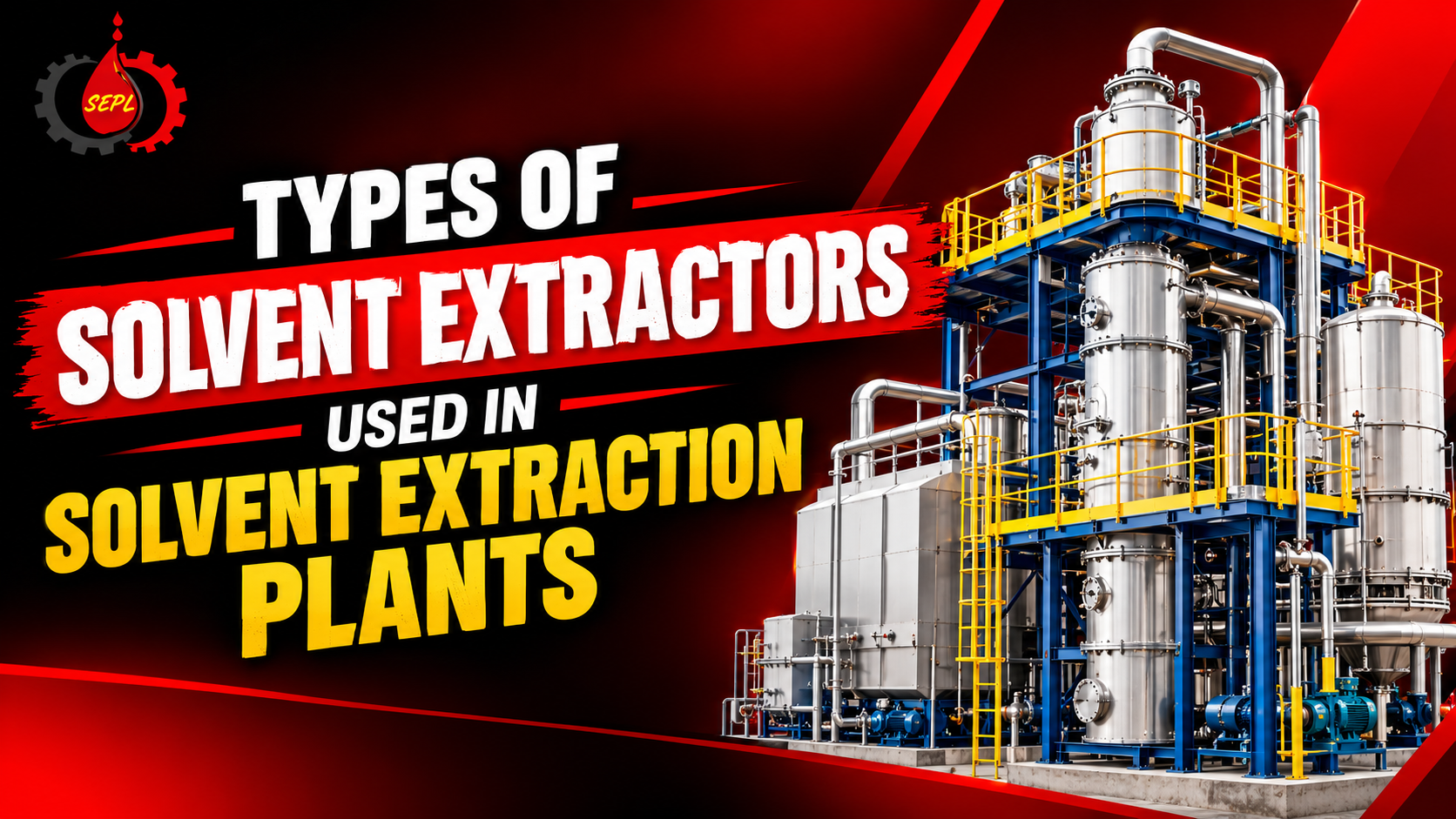
If you are planning an oil extraction project, the extractor is the first big decision you will make. It is the heart of the plant. It decides how much oil you recover, how much solvent you lose, and how smoothly your daily operation runs.
In this guide, we explain the main types of solvent extractors, how each one works, and how to pick the right one for your raw material and budget. The advice here comes from common industry practice and the kind of questions plant owners ask us before starting a project.
What Is a Solvent Extractor?
A solvent extractor is a closed vessel where prepared oilseed material, such as flakes, collets, or pellets, comes in contact with a solvent. The solvent is usually food-grade hexane. It dissolves the oil from the material and carries it away as a mixture called miscella.
The leftover solid material is called marc. It then goes to the desolventizer toaster, where the solvent is removed to make de-oiled cake. The miscella goes to miscella distillation, where oil and hexane are separated. You can see the full flow in our guide to a solvent extraction plant.
How Does a Solvent Extractor Work?
Almost every industrial extractor follows the same basic idea, called percolation or counter-current washing.
- Prepared material moves slowly through the extractor.
- Fresh solvent is sprayed on the material that has the least oil left.
- Used solvent, now rich in oil, is recycled to wash fresher material.
- Rich miscella leaves at one end and oil-free marc leaves at the other.
This counter-current method gives a high oil recovery while using less solvent. The main difference between extractor types is how they move the material through this process.
Main Types of Solvent Extractors
1. Rotary Extractor (Rotocel)
The rotary extractor is one of the most widely used designs in the world. It has a large round vessel divided into cells, like slices of a cake. The cells rotate slowly around a central shaft. Material enters a cell, solvent is sprayed from above, and the liquid drains through a perforated floor. At the end of one rotation, the cell floor opens and the marc drops out.
Best for: Soybean, rapeseed, and other seeds that give firm flakes.
Advantages:
- Simple mechanical design with few moving parts
- Low maintenance and long working life
- Good for medium and large capacities
Limitations:
- Needs a good flake quality for smooth drainage
- Takes more floor space for very high capacities
If you are setting up a bean plant, read how to set up a soybean solvent extraction plant in India and see our soybean solvent extraction plant page.
2. Loop Type Extractor
A loop extractor moves material through a closed loop with both horizontal and vertical sections. Solvent is sprayed along the path, and the bed of material moves forward in a continuous layer. This design uses gravity and a slow moving bed to keep the material evenly spread.
Best for: Large capacity plants processing soybean, sunflower, and rapeseed.
Advantages:
- Excellent solvent contact
- Handles high capacities well
- Good control over bed depth
Limitations:
- Higher initial investment
- Needs skilled operators and careful setup
3. Chain or Drag Chain Extractor
In this type, a chain conveyor drags the material through a long trough while solvent is sprayed or flooded over it. The chain moves slowly, so the material gets enough time in contact with the solvent. It is a strong and simple design.
Best for: Small and medium plants, and materials that are fine or fragile.
Advantages:
- Handles difficult materials such as rice bran better than some other designs
- Easy to understand and operate
- Lower cost than many large systems
Limitations:
- Chain and sprocket wear needs regular checking
- Less suited to very large capacities
Keeping spare parts ready matters here. Our page on solvent extraction plant spares and equipment covers what to stock.
4. Horizontal Belt Extractor
A horizontal belt extractor has a moving perforated belt. Material is laid on the belt in a thin, even bed. Solvent is sprayed from above at several points while the belt travels forward. The liquid drains through the belt into collection hoppers below.
Best for: Products that need gentle handling, like sunflower, canola, and some low-oil seeds.
Advantages:
- Very gentle on the material, so fewer fines
- Uniform bed depth gives steady extraction
- Easy to watch the process
Limitations:
- Long machine, needs more floor space
- Belt maintenance is important
5. Basket or Bucket Extractor
This design uses buckets or baskets attached to a chain or wheel. Each basket carries a batch of material through the extractor while solvent is sprayed over it. The basket then tips and drops the marc at the discharge point.
Best for: Seeds that pack well, and plants where operators want mechanical simplicity.
Advantages:
- Good drainage
- Reliable continuous operation
Limitations:
- More moving parts than a rotary design
- Basket and chain maintenance is needed
6. Batch (Fixed Bed) Extractor
A batch extractor is a closed vessel that is filled with material, soaked or percolated with solvent, then emptied. The process is repeated for each batch. Because it is not continuous, it is mostly used by small units, specialty oils, and pilot work.
Best for: Low capacity plants, specialty oils such as neem or mahua, and trial runs.
Advantages:
- Low investment
- Flexible, one machine can handle different materials
Limitations:
- Needs more labour
- Lower capacity and less consistent results
- Higher solvent loss if not well managed
7. Immersion Type Extractor
In an immersion extractor, the material is fully dipped in solvent for a set time. This is useful for fine materials that do not drain well and would block a percolation bed. It is often used for very fine or sticky products and in some specialty or spent material recovery work, such as a spent earth extraction plant.
Comparison Table: Types of Solvent Extractors
| Extractor Type | Operation | Typical Capacity | Best For | Space Needed |
| Rotary (Rotocel) | Continuous | Medium to large | Soybean, rapeseed | Moderate |
| Loop | Continuous | Large | Soybean, sunflower | Moderate |
| Chain / Drag Chain | Continuous | Small to medium | Rice bran, fine material | Large |
| Horizontal Belt | Continuous | Medium to large | Sunflower, canola | Large |
| Basket / Bucket | Continuous | Medium | Packed seed beds | Moderate |
| Batch (Fixed Bed) | Batch | Small | Specialty oils | Small |
| Immersion | Batch or continuous | Small to medium | Fine, hard-to-drain material | Small to moderate |
Capacity and fit can change based on the manufacturer’s design and your raw material. Always confirm with a technical team.
How to Choose the Right Extractor
There is no single best extractor. The right choice depends on your situation. Ask yourself these questions.
- What raw material will you process?
Soybean, cottonseed, sunflower, and rice bran all behave differently. Flake strength, oil content, and fines decide which design drains and extracts best. - What is your daily capacity?
Small plants often prefer chain or batch units. Larger plants usually go for rotary or loop designs. - How much space do you have?
Belt and chain extractors are long. A rotary design is more compact. - What is your budget?
Look beyond the purchase price. Consider power use, solvent loss, spare parts, and labour. A cheaper machine can cost more over the years. - What is the support like?
Good after-sales service, quick spares, and trained commissioning matter. Read our tips on how to choose the right solvent extraction plant manufacturer in India.
Factors That Affect Extractor Performance
Even the best extractor will perform badly if the basics are wrong. These factors matter most:
- Flake or collet quality: Thin, strong flakes allow better solvent contact.
- Moisture content: Too much moisture blocks solvent flow.
- Temperature: Hexane is usually kept in a controlled warm range to improve extraction without excess loss.
- Retention time: The material needs enough time in contact with solvent.
- Solvent flow rate: Too little leaves oil behind, too much wastes energy.
- Bed depth: An even bed prevents channeling.
When these are managed well, you can see strong gains in recovery. Learn more in our article on how a solvent extraction plant improves oil recovery.
Safety and Solvent Recovery
Hexane is flammable, so safety is not optional. Good extractors are sealed, well ventilated, and fitted with proper instruments, level controls, and explosion-proof electrics. Solvent saved is money saved, so a good hexane recovery system should work together with your extractor. Also avoid common errors by reading about oil plant installation mistakes.
Common Mistakes to Avoid
- Choosing an extractor only on price
- Ignoring raw material tests before buying
- Poor flake preparation before extraction
- Skipping regular inspection of chains, belts, and spray nozzles
- Not training operators on safety
Frequently Asked Questions
What are the main types of solvent extractors?
The common types are rotary (Rotocel), loop, chain or drag chain, horizontal belt, basket or bucket, batch fixed bed, and immersion extractors.
Which solvent extractor is best for soybean?
Rotary and loop extractors are popular for soybean because they handle flakes well and suit medium to large capacities.
Which extractor is good for rice bran?
Chain type and some specially designed extractors work well for rice bran, since bran contains fine particles that need careful handling.
What solvent is used in an extractor?
Food grade hexane is the most common solvent in edible oil extraction. It is recovered and reused in the plant.
Is a batch extractor good for a new business?
It can be a low cost way to start small or test a product. For steady commercial output, a continuous extractor is usually better.
How do I know the right extractor size?
Size depends on your daily seed throughput, oil content, and operating hours. A technical team can calculate this from your raw material and target output.
How much does a complete plant cost?
Cost depends on capacity, extractor type, and automation level. See our guide on soybean oil plant cost in India for a general idea.
Final Thoughts
Understanding the types of solvent extractors helps you make a smart, long-term decision. Rotary and loop designs suit larger plants. Chain and belt types work well for delicate or fine materials. Batch and immersion units fit small or specialty needs. Match the extractor to your raw material, capacity, space, and budget, and make sure you get strong technical support.
If you want a complete setup with one team handling design, supply, and commissioning, explore our turnkey oil plant manufacturer services, or contact us to discuss your project.