
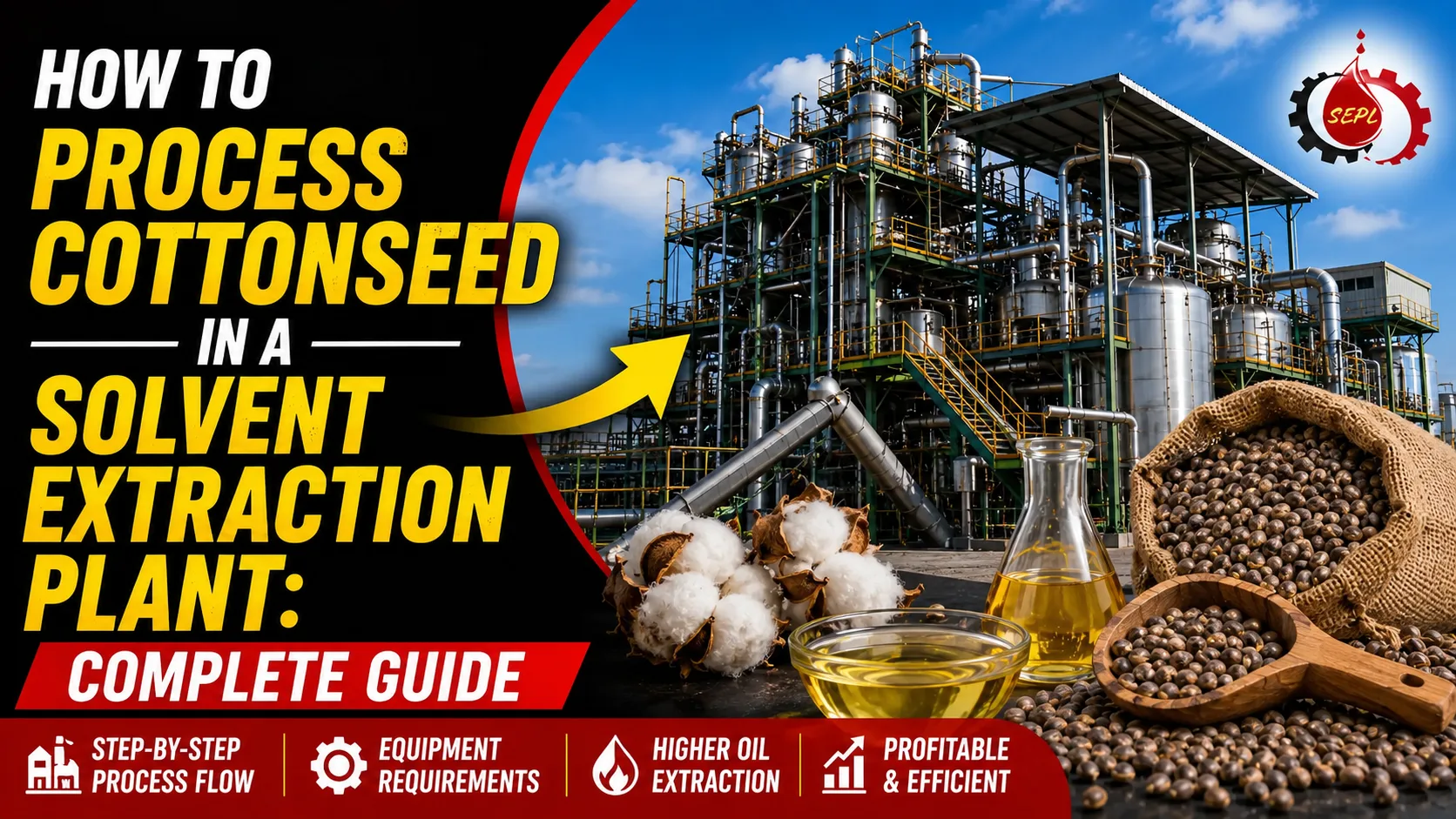
Cottonseed is one of the most complex oilseeds to process. Unlike soybean or sunflower, it comes wrapped in lint, encased in a tough hull, and contains a naturally occurring compound called gossypol that must be carefully managed during extraction. If you are planning to set up a cottonseed oil extraction plant in India or simply want to understand how the process works end-to-end, this guide breaks it down in plain language.
We cover every stage from raw seed cleaning to de-oiled cottonseed meal (DOC) bagging, the four processing methods used in industry, key quality parameters at each step, and what to look for when setting up your plant in India.
What Makes Cottonseed Different from Other Oilseeds?
Most oilseeds go straight into a cleaner and then a conditioner before pressing or extraction. Cottonseed does not work that way. The seed arrives from cotton ginning mills still covered in short lint fibers. Beneath the lint is a tough outer hull that accounts for nearly 36% to 38% of the seed by weight. Inside the hull is the kernel or meat, which carries the oil you want to extract.
This structure creates three problems that do not exist with soybean or sunflower:
- Lint clogs equipment if not removed before cracking
- Hulls dilute the meal protein and reduce extraction efficiency if mixed with the kernel
- Gossypol, a pigment gland in the kernel, is toxic to monogastric animals unless heat-treated properly
A well-designed cottonseed solvent extraction plant is built to solve all three problems systematically. Each stage of the preparatory section exists for a specific reason, not just convention.
Cottonseed Composition and Raw Material Specs
Before you feed cottonseed into any plant, you need to know what you are working with. The numbers below are typical for raw cottonseed received from ginning mills across India:
| Parameter | Typical Range |
| Moisture | 6% to 7% |
| Impurities | 2% to 3% |
| Lint on surface | 6% to 10% (max) |
| Hull content | 36% to 38% |
| Oil content (whole seed) | 15% to 20% |
| Half Oil Seeds (H.O.S.) | 26% to 30% |
| Protein (whole seed basis) | 16% to 20% |
| Kernel protein (after dehulling) | Up to 42% |
Note: Seeds with moisture above 8% should be dried before processing. Excessive moisture causes poor flaking and reduces hexane penetration in the extractor.
The Four Processing Methods: Which One Is Right for Your Plant?
There is no single way to process cottonseed. The right method depends on your capacity, capital budget, and what output quality you need. Here is a comparison of all four methods used in industry:
| Method | Best For | Residual Oil in Cake | Meal Protein | Key Limitation |
| Direct Screw Press | Small units, 10-50 TPD | 6% to 7% | Low (lint + hulls mixed in) | Dark oil, high refining cost |
| Full Press | Medium units, 50-200 TPD | 6% to 7% | Moderate | Needs solvent extraction to complete oil removal |
| Pre-Press + Solvent Extraction | 100-500 TPD plants | Below 1% | 40% to 42% | Higher capital, more stages |
| Expander + Solvent Extraction | Large plants, 200-1500 TPD | Below 1% | 40% to 42% | Higher energy in expander stage |
For any plant above 100 TPD, pre-pressing combined with solvent extraction is the industry standard in India. It gives you the best oil yield and highest meal protein, which commands a better price in the cattle feed market.
If you are evaluating capacity options for your setup, the solvent extraction plant page covers standard capacity ranges and turnkey configurations.
Complete Step-by-Step Cottonseed Solvent Extraction Process
The process from raw cottonseed to refined oil and de-oiled meal runs through two major sections: the preparatory or seed preparation section, and the solvent extraction section. Here is how each stage works.
Step 1: Cleaning and Magnetic Separation
Raw cottonseed from ginning mills carries dust, fiber fragments, stone particles, and occasionally metal pieces. The seed first passes through vibratory or rotary drum cleaners that separate light impurities by air aspiration and size. Immediately after cleaning, the seed moves through a rotary drum magnet or stationary permanent magnet to remove any iron particles or tramp metal. This step protects downstream equipment like crackers, rollers, and the extractor chain from damage.
Step 2: Delinting
Cottonseed carries 6% to 8% lint on its surface when it arrives from the ginning mill. This lint must be removed before cracking because it wraps around cracker rolls and clogs equipment. The seed passes through delinters, which are rotating blade or abrasion-type machines that strip the lint off the seed surface. Well-designed delinting reduces lint content to under 2%, converting the fuzzy seed into what is called black seed. The removed lint, called linters, is collected and pressed into bales used in the napkin and surgical cotton industries. This makes delinting a revenue-generating step, not just a preparation step.
Step 3: Seed Cracking
Black seed after delinting is too large for efficient dehulling. The seed passes through cracker rolls that break each seed into 2 to 3 pieces. Proper cracking is important because it increases the surface area exposed to the dehulling step and allows better hull-kernel separation later. Cracking should produce uniform pieces without generating excessive fines, as fines reduce extraction efficiency in the extractor.
Step 4: Decorticating and Dehulling
The cracked seed pieces enter a dehuller where hulls are separated from kernel meat. The cracked pieces rub against rubber rollers that loosen hulls from the meat without grinding the meat itself. The material then passes over shaker screens where the hull fraction and meat fraction are separated by size and density. Hull content in the seed is typically 36% to 38% by weight. Removing this hull fraction is what allows you to get kernel meat with oil content of 30% to 36%, instead of the 15% to 20% you start with in whole seed.
The spent earth extraction plant process uses a similar principle of material preparation before solvent contact, which highlights why seed preparation quality directly determines final extraction efficiency.
Step 5: Cooking and Conditioning
The cleaned kernel meat enters a cooker-conditioner where it is heated using jacketed steam and a small quantity of live steam. This step raises the temperature of the seed material and adjusts its moisture to levels suitable for flaking. Heat softens the oil cells in the seed and begins to rupture them, making oil more accessible in the flaker and easier to extract with hexane later. Typical conditioning temperature is around 70 to 80 degrees Celsius with moisture adjusted to 9% to 10%.
Step 6: Flaking
Conditioned seed meat passes through flaker rolls, typically chilled cast iron rolls fitted with a hydraulic pressure system. The rolls press the seed into thin flakes with a target thickness of 0.30 mm to 0.35 mm. Thin, uniform flakes are critical because hexane penetrates thin flakes much faster than thick ones. This directly affects the miscella concentration and the residual oil in the meal after extraction. If flakes are too thick or uneven, you end up with high residual oil in the de-oiled cake.
Step 7: Pre-Pressing (for Pre-Press Method) or Expanding (for Expander Method)
Pre-press method: Flakes are fed into a pre-press screw press where mechanical pressure removes more than 50% of the total oil in the flakes. The pressed cake comes out at around 18% residual oil and is broken into pieces that go to the solvent extraction plant. This method reduces the hexane load on the extractor because the starting oil content is lower.
Expander method: Flakes are conditioned to around 85 degrees Celsius and then passed through an expander fitted with a squeeze-o-matic arrangement. The expander compresses the flakes and releases 10% to 12% of the oil while converting the flat flakes into porous, pellet-like collets with high internal porosity. These collets, discharged at 95 to 100 degrees Celsius with 10% to 12% moisture, allow faster hexane penetration than flat flakes. A drier-cooler then brings the collets to 55 degrees Celsius and 8% to 9% moisture before they enter the extractor. Expanded collets are the preferred feed for large-capacity continuous extractors.
Step 8: Cake Sizing (for Full Press or Pre-Press Cake)
Pressed cake from the screw press comes out as large chunks. These chunks go through a cake-sizing machine that breaks them into pieces of 2 to 3 inches. Smaller, more uniform piece sizes minimize voids in the extractor bed, increase the percolation surface area, and improve hexane contact with the material. This step is often skipped or underestimated, but it directly affects extraction efficiency in the moving bed extractor.
Solvent Extraction Stage: How Hexane Removes Residual Oil
This is the core of any cottonseed solvent extraction plant process. The prepared cake, collets, or flakes enter a continuous moving bed extractor through a sealed inlet system (rotary valve or Plug-O-Seal) that prevents hexane vapors from escaping while maintaining a constant material level in the feed hopper.
How the Extractor Works
Inside the extractor, the material moves on an endless chain conveyor through a series of hopper compartments. Food-grade hexane is sprayed counter-currently over the moving material bed. Counter-current means fresh hexane enters near the exit end of the extractor where the material is already mostly de-oiled, and the hexane gradually picks up oil as it flows toward the inlet end where fresh, oil-rich material enters.
The oil-hexane mixture is called miscella. Miscella collects in the hoppers below the extractor chain and is pumped through a miscella filter or hydrocyclones to remove fine solids before going to the miscella distillation system.
Miscella Distillation
The miscella from the extractor typically contains 20% to 30% oil and 70% to 80% hexane. This mixture goes to a multi-stage evaporation and stripping system where hexane is removed in stages using steam heat. The first evaporator removes most of the hexane under vacuum at low temperature. A stripper column removes the final traces of hexane using steam stripping. The crude cottonseed oil that exits the stripper is dark in color and goes to crude oil storage for further refining.
Solvent Recovery and Condensation
Hexane vapors from the evaporators, the DT, and all other sections are recovered through a condensation system. The vapors pass through shell-and-tube condensers cooled by water, converting back to liquid hexane that is pumped to the hexane storage tank and reused. Any non-condensable vapors, along with small amounts of hexane, are passed through a mineral oil absorption unit that recovers the hexane from the vent gases before releasing them to atmosphere. This is a critical environmental and safety system. The solvent extraction plant spares and equipment required for this section include condensers, mineral oil scrubbers, and safety pressure relief valves all of which need to be correctly sized for cottonseed processing.
Meal Desolventization in the DT
The spent meal leaving the extractor still contains 25% to 35% hexane by weight. This wet meal is transported through a sealed conveyor to the Desolventizer-Toaster (DT). Inside the DT, indirect steam in the jacket heats the meal while direct steam is sparged through the meal bed. The heat and steam drive hexane vapor out of the meal. The meal is toasted in the lower sections of the DT at 100 to 110 degrees Celsius. The DT serves two purposes: it removes hexane (desolventization) and it heat-treats the meal to neutralize anti-nutritional factors including free gossypol (toasting). The hexane removed in the DT is sent to the condensation system for recovery.
Gossypol: What It Is and How the DT System Handles It
Gossypol is a yellow pigment found in small glands distributed throughout the cottonseed kernel. It is toxic to monogastric animals like pigs and poultry in its free form and must be reduced in the de-oiled meal to safe levels before the meal can be used as animal feed.
The good news is that the DT toasting stage handles this automatically when operated correctly. During toasting at 100 to 110 degrees Celsius, free gossypol binds to the protein in the meal through a chemical reaction, converting it to bound gossypol, which is non-toxic and safe for livestock feed including ruminants like cattle, buffaloes, and sheep. This is why the DT discharge temperature and residence time are critical operating parameters in a cottonseed plant, not just for hexane removal but also for gossypol management. A properly operated DT reduces free gossypol in the meal to below 0.04%, which meets international feed safety standards.
De-Oiled Cottonseed Meal (DOC): Output Quality and Uses
The toasted meal from the DT goes through a meal cooler that brings the temperature down to 10 degrees above ambient. Any lumps in the meal are screened out and ground to the required particle size. The final de-oiled cottonseed meal is bagged in 50 to 75 kg bags through an automatic bagging machine.
Here are the standard output specifications for de-oiled cottonseed meal produced from a well-run plant:
| Parameter | Standard Specification |
| Residual oil in meal | 0.6% to 0.8% max |
| Moisture | 9% to 10% |
| Residual hexane (ppm) | Below 600 ppm |
| Crude protein | 40% to 42% |
| Free gossypol | Below 0.04% |
De-oiled cottonseed meal is a high-value protein ingredient used in cattle feed, poultry feed (in limited quantities), and aquafeed. At 40% to 42% protein, it competes directly with soybean meal as a protein source in compound feed formulations. This makes de-oiled cottonseed meal production a significant revenue stream for any cottonseed oil extraction plant, often accounting for 60% to 70% of total plant revenue.
For plants that also produce livestock feed pellets, the cattle feed plant setup can be integrated to convert de-oiled meal and other ingredients directly into finished feed pellets on the same site.
Cottonseed Oil Extraction Plant Setup in India: Key Considerations
India is one of the largest cottonseed producers in the world, with major growing regions in Gujarat, Maharashtra, Telangana, Andhra Pradesh, Karnataka, and Rajasthan. This makes cottonseed processing a commercially strong opportunity, especially for ginning mill owners looking to add a processing unit downstream.
Capacity Planning
Plants in India typically start at 50 TPD (tonnes per day) and scale up to 500 TPD or more depending on cottonseed availability in the region. A 100 TPD pre-press solvent extraction plant is a common entry point for entrepreneurs in cotton belt states. At 100 TPD, you process approximately 3,000 tonnes per month during the crushing season (typically October to April) with seasonal operation factored in.
Raw Material Availability and Season
Cottonseed is a seasonal commodity. The main supply flush comes from October to January after the Kharif cotton harvest. Plants typically operate at full capacity for 5 to 7 months and at reduced capacity or on stored inventory for the rest of the year. Raw material procurement strategy and seed storage capacity planning are as important as plant selection.
Regulatory and Quality Standards
In India, cottonseed oil for edible use must meet FSSAI (Food Safety and Standards Authority of India) standards after refining. The crude cottonseed oil produced from solvent extraction goes to a refinery for degumming, neutralization, bleaching, and deodorization before it is fit for edible use. The de-oiled meal must comply with BIS (Bureau of Indian Standards) specifications for animal feed use, particularly for residual hexane and gossypol levels.
Infrastructure Requirements
A greenfield cottonseed solvent extraction plant needs adequate land for the main plant, seed storage, crude oil tanks, hexane storage (classified as a hazardous chemical under PESO regulations), boiler house, cooling tower, and finished goods warehouse. Hexane storage and handling must comply with the Petroleum Act, 1934 and require PESO (Petroleum and Explosives Safety Organisation) approval before commissioning.
The material handling equipment selection for the plant, including conveyors, bucket elevators, and rotary airlock valves, needs to be designed for cottonseed’s specific bulk density and flow characteristics, which differ from soybean or sunflower.
Turnkey vs. Piecemeal Procurement
Most plant owners in India prefer a turnkey manufacturer who supplies the complete system from seed intake to oil storage and meal bagging, including civil and installation support. This reduces coordination complexity and ensures that each section is designed to work with the others. Super Techno Engineers supplies complete cottonseed solvent extraction plants on a turnkey basis with capacities from 50 TPD to 1500 TPD. For plants that also need an integrated refinery, the edible oil refinery plant can be added as a downstream unit on the same site.
Frequently Asked Questions
Q.1 What is the residual oil in cottonseed cake after solvent extraction?
In a properly operated solvent extraction plant using pre-pressed cake or expanded collets as feed, residual oil in the de-oiled cake is maintained below 1.0%, typically in the range of 0.6% to 0.8%. This is significantly better than screw pressing alone, which leaves 6% to 7% oil in the cake.
Q.2 Is gossypol in cottonseed meal dangerous for animals?
Free gossypol in its raw form is toxic to pigs and poultry. However, the DT toasting stage in a solvent extraction plant binds free gossypol to protein, converting it to bound gossypol, which is safe for ruminants like cattle and buffaloes. A properly toasted de-oiled cottonseed meal with free gossypol below 0.04% is accepted in cattle and buffalo feed formulations worldwide.
Q.3 What capacity cottonseed plant is right for me?
For ginning mill owners adding a processing unit, a 50 to 100 TPD plant is a practical starting point. For standalone cottonseed crushing units targeting regional oilseed procurement, 100 to 200 TPD is more common. Larger cooperatives or industrial groups operating in major cotton belt states typically look at 300 TPD and above. Capacity should match your reliable seed procurement volume, not peak availability.
Q.4 Can cottonseed be processed without delinting and dehulling?
Yes, in the Direct Screw Press method, whole cottonseed including lint and hulls is processed without separation. This works for very small units (under 50 TPD) and produces oil that requires higher chemical consumption during refining. Meal protein is also lower at 20% to 26% instead of 40% to 42%, which reduces meal value significantly. For any serious commercial operation, delinting and dehulling are worth the investment.
Q.5 What is the hexane consumption in a cottonseed extraction plant?
Typical hexane consumption in a well-maintained solvent extraction plant is 1 to 1.5 kg per tonne of feed material processed. Higher consumption usually indicates leaks in the system, poor condensation efficiency, or equipment wear. Regular maintenance of the mineral oil absorption unit and checking all flanges and seals is the most effective way to control hexane consumption.
Q.6 How long does it take to set up a cottonseed solvent extraction plant in India?
Civil construction and equipment fabrication together typically take 8 to 14 months for a greenfield plant of 100 to 200 TPD capacity. This includes time for PESO approval for hexane storage, which adds 2 to 4 months depending on the state. Working with a turnkey manufacturer who handles equipment supply, erection supervision, and commissioning reduces delays significantly.
Final Thoughts
The cottonseed solvent extraction plant process is more involved than most other oilseeds, but the payoff is proportional. You get crude cottonseed oil with low residual FFA when the process is well-controlled, and de-oiled cottonseed meal at 40% to 42% protein that commands strong prices in the cattle feed market. The key to a profitable plant is getting the seed preparation section right, specifically delinting, dehulling, and flaking, before the material ever reaches the extractor.
If you are evaluating a cottonseed oil processing plant setup in India, understanding each stage of this process will help you ask the right questions when you talk to manufacturers, evaluate quotes more accurately, and make better decisions on capacity and configuration.
Super Techno Engineers designs and supplies complete solvent extraction plants for cottonseed and other oilseeds across India. To discuss your project requirements, visit solventextractionplant.com.