
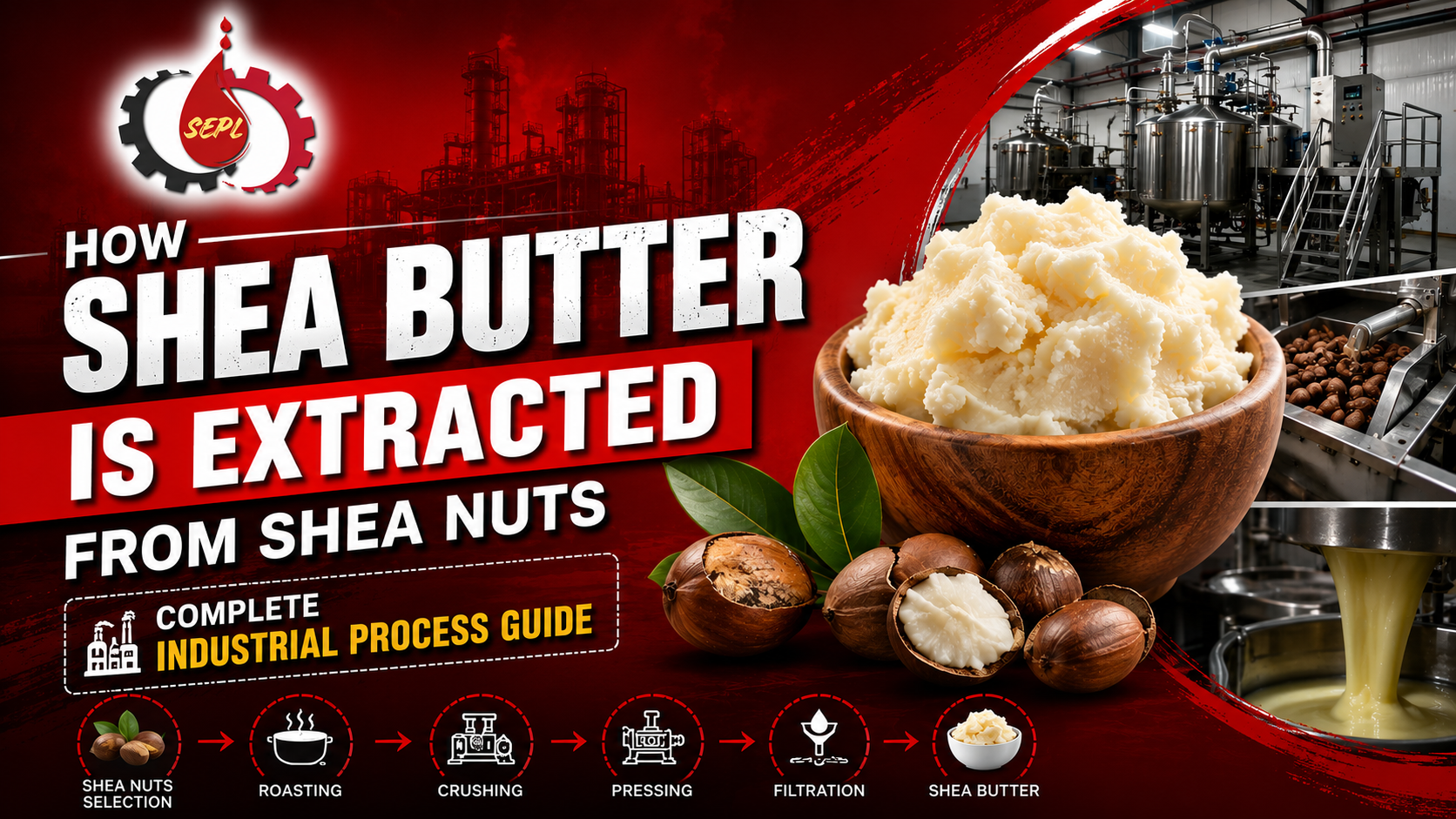
Shea butter is one of the most sought-after natural fats in the world, prized by cosmetics brands, pharmaceutical manufacturers, and confectionery giants alike. But very few people outside the edible oil industry understand what actually happens between a wild-harvested shea nut and the smooth, ivory-colored butter that ends up in a jar of body lotion or a bar of chocolate.
This guide breaks down the complete shea butter extraction process from raw nut to finished butter, the way it actually happens inside a modern industrial plant, drawing on real plant engineering practices followed by manufacturers like Super Techno Engineers Private Limited. Every shea nut entering the plant goes through precision cleaning, cracking, and conditioning, rupturing oil cells completely before hexane solvent extraction begins, ensuring full fat accessibility and maximum yield from every ton processed. Whether you’re an entrepreneur evaluating a sheanut solvent extraction plant, a procurement manager researching shea nut oil extraction machinery, or simply curious about how this “women’s gold” of Africa reaches global markets, this article covers every stage in detail.
1. What Is Shea Butter and Why Does It Matter
Shea butter is a naturally occurring fat pressed and extracted from the kernel of the shea tree seed. Unlike most vegetable oils that remain liquid at room temperature, shea butter is semi-solid, rich in oleic and stearic acids, and loaded with vitamins A and E along with natural antioxidants. This unique fatty acid profile is exactly why it performs so well in skincare formulations, pharmaceutical ointments, and as a stand-in for cocoa butter in chocolate manufacturing.
Commercial interest in shea butter has grown steadily for decades, driven by clean-label skincare trends and its recognized status as a cocoa butter equivalent (CBE). But turning a hard, dry shea nut into refined, export-grade butter is not a simple task it requires a carefully engineered shea butter extraction process, which is where a purpose-built shea nut oil extraction machinery setup becomes essential.
2. The Shea Nut: Raw Material Behind the Butter
The shea nut is the seed of the African shea tree (Vitellaria paradoxa), a wild-growing species native to the dry savannah belt that stretches from Senegal in the west across to Sudan and into the Ethiopian highlands. It grows across roughly 21 African countries, including Ghana, Nigeria, Burkina Faso, Mali, and Uganda, where it has supported rural livelihoods and local economies for generations.
Historical records trace shea butter extraction back to at least the 14th century in Africa, with commercial exports to Great Britain documented as early as 1846. Today it remains one of the most actively traded natural fats globally.
What makes shea nuts commercially attractive for processors is their exceptionally high fat content, up to 45% oil by weight. This puts shea among the richest oil-bearing seeds handled by any industrial extraction facility, but it also means the raw material demands specialized handling. Because shea butter solidifies at room temperature, standard oilseed processing equipment designed for soybean, sunflower, or groundnut is not well suited to shea. Every stage of the shea butter extraction process, from the cooker to the distillation system, has to be engineered specifically around shea’s unique melting and viscosity behavior.
3. Overview of the Shea Butter Extraction Process
At a high level, industrial shea butter production combines two extraction philosophies working together:
Mechanical extraction (pressing): Physical pressure squeezes oil out of the conditioned nut material using a screw press.
Solvent extraction: A food-grade hexane solvent dissolves the remaining oil trapped inside the pressed cake, pulling recovery rates up close to their theoretical maximum.
Used together, pre-press followed by solvent extraction this combination is what allows a modern industrial shea butter production plant to push residual oil in the spent meal down below 1%, a recovery level that pure mechanical pressing alone simply cannot achieve.
4. Step-by-Step Shea Butter Extraction Process
Step 1: Shea Nut Cleaning
Raw shea nuts arriving from harvest points and local traders are rarely clean. They typically carry dust, leaf debris, twigs, and small stones picked up during collection and transport. Before any processing begins, the nuts pass through vibratory screens or rotary drum cleaners that sieve out this foreign material. Clean input at this stage sets the tone for consistent extraction results downstream; contaminated feedstock leads to uneven cracking, wasted capacity, and equipment wear.
Step 2: Magnetic Separation
Even after cleaning, tiny metal fragments nails, wire, or tramp iron picked up during harvesting and handling can remain mixed in with the nuts. Passing the material through a rotary drum or stationary permanent magnets removes these particles before they reach the cracking rollers. This isn’t a cosmetic step; it’s essential protection for expensive downstream machinery like crackers and presses.
Step 3: Cracking
Shea nuts, averaging around 20–25mm in diameter, move through chilled cast iron roll crackers that break each nut into roughly 4 to 8 uniform pieces. Getting this particle size right matters enormously; pieces that are too large won’t condition or press evenly, while over-cracked material can clog downstream equipment. Correct cracking size is one of the most under-appreciated variables in efficient shea processing.
Step 4: Cooking / Conditioning
This is arguably the most critical and most shea-specific stage in the entire process. Cracked nut pieces enter a purpose-built cooker-conditioner, heated using a jacketed steam system combined with controlled live steam injection. Since shea butter is solid at room temperature, the material must be tempered to somewhere between 90°C and 105°C to liquefy the fat enough for efficient pressing.
Standard cooker-conditioners built for common oilseeds are not adequate here; shea’s high fat content and solidification behavior demand equipment engineered specifically for this raw material.
Step 5: Pressing (Pre-Press or Full Press)
Once conditioned, the warm shea material is fed into a screw press, where mechanical force expels the first portion of oil.
Pre-Press Method: Roughly 30% of the available oil is expelled at this stage, leaving a cake with 15–20% residual oil, discharged at 90–100°C. This cake then moves forward into solvent extraction.
Full Press Method: A more aggressive pressing cycle extracts around 38% of the oil, bringing residual oil in the cake down to just 7–8%. This route suits operations aiming to maximize mechanical recovery ahead of solvent processing.
Step 6: Cake Breaking
The pressed cake exits the screw press in irregular clumps. Roll breakers fitted with breaking knives cut this material down into consistent 2–3 inch fragments. Uniform cake size matters because it directly determines bed depth and permeability inside the moving-bed extractor later in the line. Inconsistent sizing creates voids and uneven solvent penetration, which hurts extraction efficiency.
Step 7: Cooling
Before the cake can enter the solvent extraction system, it needs to be cooled down to around 55°C. This isn’t optional; hexane, the solvent used in extraction, cannot be safely introduced above this temperature range. A dedicated cooling stage brings the cake to a safe, stable temperature before it’s conveyed into the extractor.
Step 8: Solvent Extraction
This is the heart of the entire shea butter extraction process. The cooled, pre-pressed (or fully pressed) cake enters a Moving Bed Extractor through a sealed feed system. Food-grade hexane is sprayed counter-currently across the moving bed of material, dissolving the fat still locked inside the cake to form what’s called “miscella,” a hexane-oil solution.
The miscella is filtered and pumped to a holding tank, where it later undergoes distillation to separate the hexane (which is recovered and recycled) from the crude shea butter. Meanwhile, the de-oiled cake exits the extractor through a sealed discharge system and moves on to the Desolventizer Toaster (DT) for final solvent removal. This stage is what a sheanut solvent extraction plant is built around, and it’s where the vast majority of remaining oil is finally recovered.
Step 9: Meal Conditioning & Bagging
De-oiled shea cake leaves the Desolventizer Toaster at around 110°C and is cooled down to roughly 10°C above ambient temperature before being automatically bagged, typically in 50–75kg sacks. The finished de-oiled meal generally has a moisture content of 11–12% and residual oil of just 1–1.5%, low enough to be sold as a high-protein animal feed ingredient or used as boiler fuel, ensuring virtually zero waste from the production line.
Step 10: Miscella Distillation & Butter Recovery
Separately, the hexane-oil miscella collected during extraction goes through a multi-stage distillation system. Because crude shea butter is significantly more viscous than typical vegetable oils, this stage needs equipment specifically engineered to handle that viscosity without fouling or inefficient heat transfer. The result of this stage is crude shea butter, ready either for direct export or further refining into cosmetic or food-grade butter.
5. Mechanical vs Solvent Extraction: Comparison Table
| Parameter | Mechanical Extraction (Pressing Only) | Solvent Extraction (Hexane-Based) |
| Oil Recovery Rate | 30–38% of available oil (pre-press to full press) | Up to 98–99% of available oil |
| Residual Oil in Meal | 7–20% (pre-press to full press) | Below 1% |
| Capital Investment | Lower upfront cost | Higher upfront cost |
| Operating Cost per Ton | Higher (due to lower yield) | Lower per ton processed at scale |
| Throughput Suitability | Small to medium scale | Medium to large industrial scale (50–1000 TPD) |
| Butter Quality | Good, but higher free fatty acid content over time | Consistently premium, ready for refining |
| By-Product Value | Higher oil content in cake reduces feed-grade value | Low-oil meal ideal for feed/fuel use |
| Best Suited For | Small cooperatives, artisanal producers | Industrial shea nut processing plant operations |
In practice, most modern facilities don’t choose one method exclusively; they combine pre-pressing with solvent extraction to get the best of both: strong initial mechanical yield followed by near-complete recovery through solvent processing.
Plant Specifications at a Glance
| Parameter | Standard Value / Details |
| Plant Capacity | 50 TPD to 1000 TPD (Tonnes Per Day) |
| Raw Material | Shea Nuts / Shea Kernels |
| Residual Oil in Meal | Less than 1.0% |
| Solvent Used | Food Grade Hexane |
| Solvent Loss | Less than 2.5 Litres per Ton of material |
| Material of Construction | Carbon Steel / Stainless Steel (product-contact parts) |
Equipment comes standard with these specifications. Options and modifications are available as per client needs.
6. Role of a Sheanut Solvent Extraction Plant
A sheanut solvent extraction plant is what makes industrial-scale, high-recovery shea butter production commercially viable. Without it, processors are left relying on mechanical pressing alone, which leaves a significant percentage of valuable oil trapped in the cake oil that, at scale, represents real lost revenue.
Super Techno Engineers Private Limited designs its shea nut solvent extraction plants specifically around shea’s demanding physical properties: high fat content, high viscosity, and a tendency to solidify at ambient temperature. Key engineering features typically built into a well-designed plant include:
- Continuous moving bed solvent extraction for uninterrupted production at scale
- Multi-stage miscella distillation engineered for high-viscosity shea butter rather than generic vegetable oil
- Advanced vapor recovery systems that keep hexane loss to an absolute minimum, both for cost control and safety
- Heavy-gauge welded steel construction with stainless steel product-contact surfaces for long-term durability under continuous industrial operation
The end result is a plant capable of pushing residual oil in spent meal below 1%, alongside producing premium crude shea butter suitable for either direct export or further refining.
7. Key Machinery Used in an Industrial Shea Butter Production Plant
A complete shea nut processing plant is really a chain of specialized machines, each engineered for a specific stage of the process:
- Vibratory/rotary drum cleaners – remove debris and foreign matter from raw nuts
- Magnetic separators – strip out tramp iron before it damages downstream equipment
- Roll crackers – break nuts into uniform pieces for efficient conditioning
- Cooker-conditioners – purpose-built for shea’s high melting point, using jacketed and live steam
- Screw presses – mechanically expel the first portion of oil (pre-press or full press configurations)
- Roll breakers – size the pressed cake for consistent extraction bed depth
- Moving Bed Extractors – the core of the shea nut oil extraction machinery lineup, where hexane dissolves remaining fat
- Desolventizer Toasters (DT) – strip residual solvent from the de-oiled meal
- Distillation systems – separate hexane from crude shea butter in the miscella
- Vapor recovery systems – capture and recycle hexane vapor to minimize solvent losses
When evaluating a shea nut processing plant manufacturer, it’s worth asking specifically how each of these units has been adapted for shea rather than repurposed from a generic oilseed line. This is often the difference between an average-performing plant and one that consistently delivers sub-1% residual oil.
8. By-Products: Nothing Goes to Waste
A well-designed shea butter extraction process generates value from more than just the finished butter:
De-oiled shea cake — with residual oil trimmed down to 1–1.5%, this becomes a high-protein animal feed ingredient or an economical boiler fuel, closing the loop on plant energy needs.
Recovered hexane — captured through the vapor recovery system and recycled back into the extraction process, reducing both cost and environmental impact.
This near-zero-waste model is one of the strongest economic arguments for investing in a proper solvent extraction system rather than relying solely on mechanical pressing.
9. Where Industrially Extracted Shea Butter Is Used
Shea butter’s versatility is what keeps global demand climbing year after year:
Cosmetics & Skincare — A natural moisturizer widely used in creams, lotions, lip balms, and hair care formulations worldwide, valued for its skin-conditioning fatty acid profile.
Pharmaceuticals — Its natural anti-inflammatory properties make shea butter a valued ingredient in topical treatments, arthritis relief products, and wound-care formulations.
Chocolate & Confectionery — As a cocoa butter equivalent (CBE), shea butter offers global chocolate manufacturers a cost-effective, functionally similar fat substitute.
Food Industry — Approved for food use in multiple international markets, shea butter finds its way into cooking fats, margarines, and specialty food formulations.
De-Oiled Shea Cake — Even the leftover cake has commercial value, used as animal feed or boiler fuel, ensuring the production line generates value from essentially every input ton.
10. Choosing the Right Shea Nut Processing Plant Manufacturer
Not every oilseed extraction equipment supplier understands the specific engineering challenges shea nuts present. When evaluating a shea nut processing plant manufacturer, consider the following:
- Shea-specific engineering experience — Has the manufacturer built cooker-conditioners and distillation systems specifically adapted for shea’s high viscosity and solidification behavior, or are they offering generic oilseed equipment?
- Proven recovery rates — Ask for documented residual oil figures in the spent meal; sub-1% should be the benchmark for a properly engineered plant.
- Certifications — ISO 9001:2015 certification and similar quality standards indicate a manufacturing process built around consistency and accountability.
- In-house engineering and custom design capability– Every shea processing operation has different capacity needs (ranging anywhere from 50 TPD to 1000 TPD), so custom design flexibility matters.
- Turnkey support — Installation, commissioning, and operator training should be part of the package, not an afterthought.
Super Techno Engineers Private Limited, an ISO 9001:2015 certified manufacturer, designs and delivers turnkey sheanut solvent extraction plants with in-house engineering support and global installation capability, covering everything from initial plant design through to commissioning and operator training.
11. Frequently Asked Questions
Q1. What extraction efficiency can a properly engineered sheanut solvent extraction plant deliver?
A well-designed plant, combining pre-press or full-press mechanical extraction with hexane-based solvent extraction, can consistently bring residual oil in the spent meal down below 1%, close to the theoretical maximum recovery for shea nuts.
Q2. Can shea nut processing machinery handle other oilseeds as well?
Yes. While the plant is purpose-optimized for high-fat shea kernels, the system can be configured to process other oil-bearing materials such as soybeans and sunflower seeds, though the cooker-conditioner and distillation systems generally need shea-specific engineering to handle shea’s unusually high melting point and viscosity.
Q3. Why does shea butter need special handling during distillation compared to other vegetable oils?
Crude shea butter is significantly more viscous than oils like soybean or sunflower oil, and it solidifies at room temperature. Distillation and miscella-handling equipment has to be engineered around this viscosity to avoid fouling and maintain efficient heat transfer.
Q4. What utilities does an industrial shea butter production plant typically require?
Core utilities generally include steam (for cooking/conditioning and distillation), electrical power for drives and pumps, cooling water, and a controlled supply of food-grade hexane along with a vapor recovery system to manage solvent losses.
Q5. Does the manufacturer provide onsite installation and operator training?
Yes. A properly engineered shea nut solvent extraction plant should be delivered on a complete turnkey basis: mechanical installation, commissioning, trial runs, and hands-on operator training at the client’s site, so the plant runs confidently from day one.
Q6. How long does it typically take to set up a shea nut processing plant?
Manufacturing and commissioning timelines vary based on plant capacity and customization requirements; it’s best to consult directly with the manufacturer’s engineering team for a project-specific timeline.
12. Conclusion
The journey from a wild-harvested shea nut to export-grade shea butter is far more technical than most people realize. It involves precise cleaning, controlled cracking, carefully calibrated conditioning, mechanical pressing, and critical solvent extraction to capture every last percentage point of recoverable oil. Each stage of the shea butter extraction process has to be engineered specifically around shea’s unusually high fat content and its tendency to solidify at room temperature, which is exactly why generic oilseed equipment consistently underperforms on this raw material.
For processors looking to scale up, investing in a properly engineered sheanut solvent extraction plant rather than relying on mechanical pressing alone is what separates marginal recovery rates from industry-leading, sub-1% residual oil performance.
Super Techno Engineers Private Limited specializes in exactly this kind of shea-specific engineering, offering turnkey shea nut oil extraction machinery and complete industrial shea butter production plant solutions from initial cleaning and cracking systems through pressing, solvent extraction, and distillation, all the way to bagging and dispatch. For businesses evaluating their next shea nut processing plant manufacturer, understanding this full process is the first step toward making an informed, profitable investment.